Intellectual Property on Instagram: Why is Your Content at Risk?
Your unique visuals and texts on social media are not just images; they are significant assets that competitors often try to misappropriate with a single click. Let’s break down how effective intellectual property protection works for small businesses in an environment where content is constantly being copied on Instagram.
Typical Intellectual Property Infringements on Instagram
To build a solid legal defense, you must first clearly identify the methods used by digital pirates. We will examine the classification of infringements and the reasons why standard plagiarism reports are often ignored by moderators.
What Counts as Theft on Instagram

In the dynamic environment of Instagram, the line between “finding inspiration” and “stealing” often seems blurred, but the law provides clear answers. Every day, small businesses face the reality that the results of their creative work—from original product photos to unique Reels scripts—become the property of other accounts without any credit to the original source.
According to the Law of Ukraine “On Copyright and Related Rights,” your content is protected from the moment of its creation; however, on social media, you must prove this with facts. Typical manifestations of theft that we encounter in practice include:
- Direct visual copying: The use of your photographs or graphic designs for the commercial profiles of competitors. While an Instagram publication date is a weak argument, it acts, along with saved RAW files and metadata, as evidence to confirm the priority of your authorship.
- Text scraping: Duplication of product descriptions, promotional posts, or unique training methods disguised as one’s own expertise.
- Exploitation of brand elements: Placing your logo on third-party advertising mockups, which misleads customers about the manufacturer.
- Video piracy: Republishing Reels or Stories without permission, even if the watermark remains visible.
To identify an infringer, we recommend regularly monitoring the market using image search services and checking brand mentions. Formal copyright registration with the IP Office becomes the “gold standard” that resolves all questions from Instagram moderators regarding the owner of an asset. Possession of a certificate allows you not only to request the removal of a post but to demand the blocking of content based on an official document.
However, even with all the evidence in hand, brand owners often face the issue of their requests being ignored by the platform’s support team.
Why copyright complaints are ignored
When you submit a complaint via the standard Instagram form, a moderator evaluates the application through the lens of the platform’s internal policies and DMCA requirements. Social media algorithms often ignore these requests because, without verified data, they are treated as subjective assumptions. The platform strives to avoid erroneous blocks, which is why priority is given to requests that include links to official registries, such as the State Register of Certificates for Trademarks and Services of Ukraine.
The main problem lies in the lack of a presumption of authorship that a moderator could verify instantly. Posting a photo before the infringer is only an auxiliary argument, which is not considered convincing evidence without fixed metadata or original RAW files. That is precisely why state copyright registration is critical for small businesses: it transforms your complaint into a substantiated claim that Meta processes as a priority.
Comparative effectiveness of content protection
| Situation | Basis of complaint | Typical result |
|---|---|---|
| Without registration | Reference to publication date (“I posted it first”) and metadata | High risk of refusal; weak evidentiary base without official certification. |
| With a certificate | Copy of the official Copyright Registration Certificate | High probability of content removal within 24–48 hours. |
Typical mistakes that lead to complaints being ignored include: appealing only to ethical norms, failing to provide direct links to the original content, or misclassifying the violation (e.g., complaining about “idea theft” instead of a specific copyrighted work). Securing rights allows a business owner to shift from trying to “negotiate” with the infringer to legitimate protection of their digital assets.
Related material on the topic: Name verification.
Case study: a real battle for content
Let’s look at practical scenarios of fighting for original content, where we will analyze a real history of successful plagiarism removal and break down critical mistakes that often prevent entrepreneurs from defending their interests on social media.
A history of successful content removal

In our practice, there was a telling case involving a small business in the niche cosmetics industry. A client discovered that a competitor had completely copied a series of original photos for an advertising campaign. An initial attempt to complain through the standard Instagram interface ended in refusal: moderators could not definitively establish the rights holder based solely on visual similarity.
The situation changed when we provided evidence from the state registry administered by the Ukrainian National Office for Intellectual Property and Innovations (UANIPIO). Official copyright registration became the key tool that allowed us to successfully initiate the DMCA (Digital Millennium Copyright Act) procedure. For platforms like Meta, a certificate is not just a piece of paper, but legal proof of priority that significantly accelerates the review process.
Step-by-step content removal algorithm:
- Evidence collection: Saving direct links and screenshots confirming the use of your content by another party.
- Rights verification: Providing a copy of the Certificate as proof of ownership of the copyrighted work.
- Filing a complaint: Filling out the specialized legal form provided by Meta for rights holders, where you specify the number and date of issuance of the state document.
- Result: Within 24–48 hours, Meta removes the disputed content, and the infringer’s profile receives an appropriate warning (strike).
It is important to understand that official registration does not guarantee automatic removal in all cases, as decisions are made by social media moderators in accordance with their internal regulations. However, it shifts the dialogue with technical support into the realm of legal obligations, minimizing the chances of rejection due to “insufficient evidence.”
Typical mistakes of business owners
A common mistake among business owners is the expectation that public complaints or emotional comments will replace official protection procedures. Social media platforms do not act as arbiters in private disputes: without documented proof of your rights, the platform often ignores appeals, perceiving them as subjective remarks. While publication dates or screenshots of working materials can serve as supporting arguments, they do not constitute sufficient legal proof. Relying solely on them gives the plagiarist time to conceal evidence or even initiate a retaliatory ban on your profile.
The state of relationships with contractors is also a critical aspect of security. Many entrepreneurs mistakenly believe that paying a designer automatically transfers property rights to the content. However, according to the standards of the Law of Ukraine “On Copyright and Related Rights,” in the absence of an explicit clause in the contract regarding the transfer of rights, the creator remains the owner. A lack of proper contracts or copyright registration leaves businesses vulnerable to unscrupulous competitors, as the formal absence of intellectual property owner status makes it impossible to effectively apply DMCA tools.
A established legal position, supported by a state certificate, changes the status of your request from a “request to look into it” to a “legal demand,” which moderators process according to established priority rules. Timely copyright registration is the foundation that turns your intellectual capital into a protected asset, minimizing risks to the company’s reputation and revenue.
A step-by-step plan for protecting your brand
To ensure effective intellectual property protection on Instagram, small business owners should follow a strategy of proactive right fixation. Instead of relying on chance, it is advisable to formalize your status as an author, which allows you to use DMCA tools for the rapid removal of plagiarism within 24–48 hours. Professional copyright registration turns your appeals to Meta support from subjective complaints into legally grounded demands, backed by a state certificate.
Anton Polikarpov, a lawyer with over 20 years of experience, recommends implementing hidden “digital fingerprints” or metadata at the content creation stage to confirm file creation dates, and always marking visual materials with the company logo. Please note that this material is for informational purposes only and does not replace individual legal consultation, as the legal position depends on current legislation, which you can verify on the official portal of the Ukrainian National Office for Intellectual Property and Innovations (UANIPIO).
Checklist of preventive measures
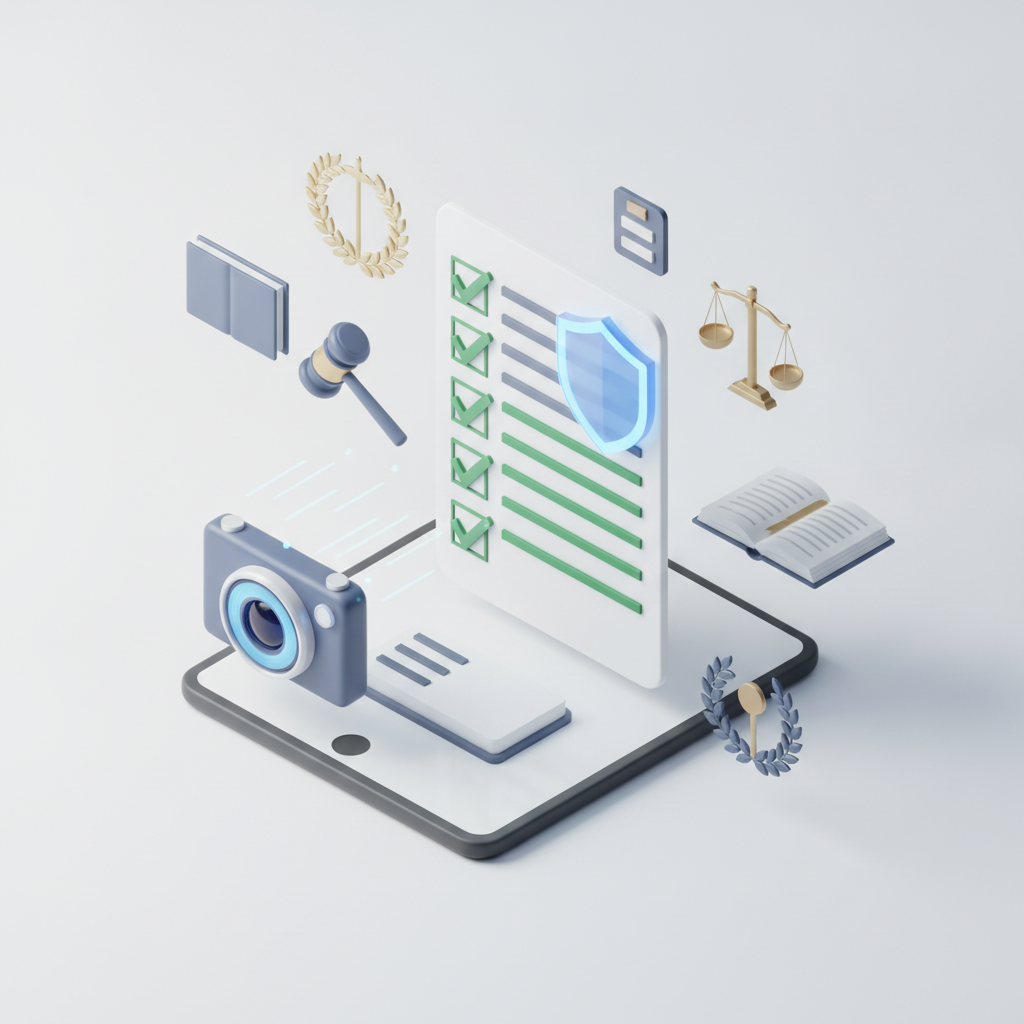
Preventive measures are your first line of defense. Instead of reacting post-factum, you establish conditions under which copying becomes a legally risky and technically complex task for the infringer. After all, social media moderators work based on formal criteria: the more “digital footprints” you have recorded, the higher the chances of immediate removal of plagiarism.
Here is a list of actions you should take today:
- Marking visual content. Use watermarks with the brand name or the © symbol. This will not stop a professional pirate, but it will serve as direct evidence of intentional infringement when filing a complaint.
- Saving source files. Keep RAW photos, editing projects, or sketches. In the event of a dispute, these materials will confirm your priority.
- Legal transfer of rights. If content is created by contractors, be sure to sign contracts that clearly state that property rights to the objects are transferred to your company.
- Official registration of authorship. The most effective tool remains copyright registration for key brand elements. A certificate automatically moves any complaint into a priority category for review.
- Market monitoring. Regularly check relevant hashtags and competitor accounts to stop the spread of plagiarism at an early stage.
Expert Advice from Anton Polikarpov
Meta’s technical algorithms operate on more complex mechanisms than a simple check of the upload date. The system analyzes the unique digital fingerprint of a file, so even overlaying third-party music or filters will not hide the original source.
Advice from Anton Polikarpov: When evaluating the originality of content, social media bots take into account metadata and the history of file manipulations. If a business uses other people’s materials, the algorithm identifies this as secondary content, which leads to a decrease in reach. To ensure the reliable legal status of your creative work, the best solution is copyright registration, which allows you to confirm priority at the legislative level.
In conflict situations on Instagram, the advantage goes to the party whose rights are backed by official data from state registries, such as UANIPIO. The social network’s technical support responds to such arguments much faster than to subjective complaints. Treat your photos, texts, and designs as assets that require not only a creative approach but also a clear system of legal documentation.
If you need help with this task, please use our copyright registration service.
Your Content Is Your Asset: Take the First Step
In the dynamic world of social media, intellectual property requires a systematic approach rather than reactive protection after the fact. Therefore, to build a comprehensive security foundation, I recommend studying our legal survival strategy for the market. Your content is capital that converts follower loyalty into profit, and only government confirmation of your rights turns digital assets into real tools of influence. The Brandr Legal team is ready to handle all bureaucratic aspects to ensure reliable intellectual property protection for small businesses and guarantee you peace of mind while growing your business.
Frequently Asked Questions
Does copyright registration for content also protect my brand name?
No, copyright registration and trademark registration are two fundamentally different intellectual property protection mechanisms.
Copyright applies exclusively to the form of expression of a creative idea: texts, photographs, illustrations, videos, or website design. It does not protect the business idea itself, the company name, or a slogan.
If you want to protect your brand name, logo, or product line names from being used by competitors, you must go through the trademark registration procedure. Only a trademark grants exclusive rights to use a brand name in commercial activities, which is critical for scaling a business and protecting it against unfair competition.
What should I do if my contractor (designer or SMM specialist) refuses to transfer rights to the created content?
According to Ukrainian law, by default, the economic rights to a work created under a contract belong to the author (contractor) unless otherwise specified in the agreement. This means that without a written document, you are formally not the owner of the content you paid for.
How to secure your business:
- Always sign an agreement on the transfer (alienation) of economic rights or include a relevant clause in the service agreement.
- Clearly define the subject of the contract: state that the client receives the full scope of intellectual property economic rights for all work results, including source files.
- Keep payment documents and correspondence as additional proof of your arrangements.
If no agreement was signed, you risk receiving a claim from the former contractor if you start using their work on a scale that exceeds the initial arrangements.
Is there a difference in how product photos and creative content are protected?
From a legal perspective, both product photos and creative content (e.g., lifestyle shots) are protected as objects of copyright. However, in practice, courts and platforms pay more attention to the level of “creative contribution.”
Professional product photography using lighting, composition, and styling has a high degree of protection. A simple, standard photo of a product on a white background (“packshot”) is harder to protect due to its utilitarian nature. To minimize risks, we recommend:
- Registering the rights to a series of photographs as a single, cohesive object.
- Storing RAW files and image metadata as proof of the creation date.
- Conducting an official copyright registration for the brand’s key visual assets, which will allow you to easily use certificates when filing complaints on social media.
How can I protect a business idea that does not yet have a material form as content?
You should remember that copyright does not protect ideas—it only protects their specific expression (implementation). If you only have a business concept, you cannot register a copyright for it.
However, you can protect your business at the development stage using the following tools:
- Non-Disclosure Agreement (NDA) with partners, developers, or employees. This obliges them not to disclose your trade secrets and project details.
- Documentation of development stages: logging business processes, describing algorithms, or creating schematic models, for which you can already obtain a copyright.
- Trademark registration at early stages to reserve the project name while you work on bringing the idea to life.
Do I need to register a copyright for each social media post separately?
Registering every individual post is impractical due to the frequent updates of content. The legally sound strategy for a small business is depositing and registering cycles or thematic blocks of content.
You can register economic rights for:
- The entire feed design (visual style and grid).
- Series of videos linked by a single concept.
- Collections of texts or content plans for a specific period.
Registering a copyright for such “content packages” creates a strong legal foundation. Having a single certificate for a series of content significantly increases the chances of having stolen material removed quickly, as you are confirming your legal standing regarding a large array of brand assets.