IT Product: What to Choose for Protection?
When you create a software product, the choice between patenting an algorithm and protecting the code determines your business’s future security. Understanding what a patent for an invention or copyright entails and the differences between them will help a startup avoid fatal mistakes right from the start.
Copyright: Basic Code Protection
For most developers, copyright becomes the first line of defense for intellectual assets due to its simplicity of registration. We will look into which software elements are eligible for protection and what the basic workflow for a rights holder looks like.
What Exactly Does Copyright Protect
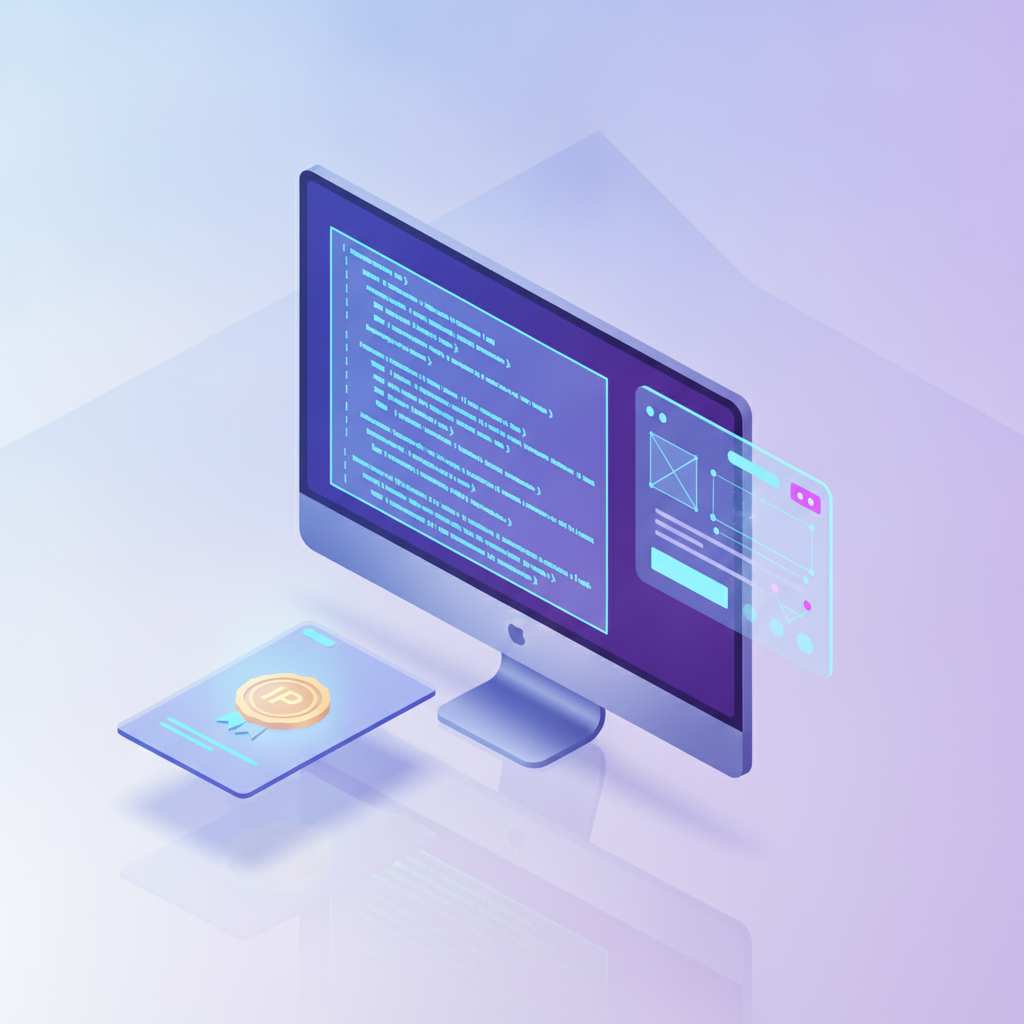
In the IT industry, this mechanism works on the principle of protecting literary works: it protects the specific form of expression, not the idea or method itself. Your code is protected as text, which makes this tool extremely accessible, as rights arise automatically the moment the first line is written. However, for full registration and to obtain an official certificate, it is worth clearly distinguishing the objects that can be protected.
Intellectual property protection for small businesses in the digital sphere usually covers a whole range of product components. Although the difference between patents and copyright lies in the object of protection, the latter allows you to quickly “claim” the following elements:
- Source and object code: the core of your program.
- Graphical user interface (UI): visual design and element layout.
- Technical documentation: instructions, architecture descriptions, and specifications.
- Databases: structure and content (if it is the result of creative effort).
- Audiovisual elements: videos within the app, sound effects, and music.
This approach allows you to quickly establish authorship, which is critical when you are looking for ways to protect a business idea from theft through code copying. However, keep in mind: if a competitor writes software with similar functionality but in a different programming language or with a different structure, legal protection here will not help—and this is where the key difference from patenting becomes apparent.
To minimize risks and have solid evidence in court, it is necessary to properly follow the rights registration procedure.
Copyright Registration Checklist
Official registration of intellectual property for software, provided by the Ukrainian National Office for Intellectual Property and Innovations (IP Office), is an effective tool for building an evidentiary base. Although according to Article 11 of the Law of Ukraine “On Copyright and Related Rights,” property rights arise automatically from the moment the code is created, having a certificate significantly facilitates asset protection in court and the audit process during investment rounds.
Algorithm for Developers
- Source Code Audit: Prepare a code fragment that identifies the product for deposit. This is technical hygiene: before submission, remove confidential data such as API keys or database passwords, as they are not subject to legal registration.
- Digital Timestamping: Before filing the application, document the state of the code via Git commits or digital signatures. This serves as proof of development priority over time.
- Legal Formalization of Rights: Ensure that all contracts with your team (including freelancers) include clauses transferring property rights to the client or employer.
- Document Submission: The procedure includes filing an application, a copy of the code, and paying the fee. Professional registration minimizes the risk of formal errors that could lead to the rejection of your documents.
Practical Tip: If you are working on a unique algorithm that provides a technical advantage, consider combining copyright (for the form of expression) and patenting (for the method as an invention). This creates a “double shield” for your IT product.
Patent for Invention: Protecting Functionality
Patenting in the IT industry provides a monopoly on a technical solution or algorithm. While this path is more complex than registering authorship, it protects the actual logic of the product, regardless of the programming language or interface design.
Patentability Criteria for IT Solutions
For a software solution to receive invention status, it must go beyond mere coding and solve a specific technical problem. In Ukraine and EU countries, patenting “pure” software is prohibited; however, algorithms that control physical processes, signal processing, or server resource optimization can certainly become objects of industrial property.
The main difference between a patent for an invention and copyright lies in the requirements for the object. While originality of form is sufficient for authorship, a patent must meet three strict criteria, which are verified during the qualification examination at the IP Office.
| Criterion | Essence of the requirement for an IT solution |
|---|---|
| Novelty | The solution must not be known globally prior to the filing date. Any public release of the source code before filing destroys novelty. |
| Inventive Step | The algorithm must not be obvious to an experienced developer (Senior/Lead). It must represent a non-obvious advancement in technology. |
| Industrial Applicability | The solution must be technically implementable and yield a concrete practical result in any field of industry. |
Code as such (syntax) cannot be patented, as it is considered a form of expression similar to a literary work. It is the “method” or “process” of component interaction within a system that is patented. For example, if you have developed a unique method for lossless data compression, you are patenting the processing method, not the specific lines of C++ or Python.
However, the path to obtaining such protection comes with specific challenges that can be critical for the dynamic IT market.
Risks of patenting software algorithms
Patenting in IT is a process with high demands for legal and technical argumentation. Unlike copyright, which secures the code text itself, a patent protects a unique method or algorithm that provides a technological advantage. However, choosing to patent carries significant risks, as it requires public disclosure of the invention’s essence, making it visible to competitors even before the protection document is granted.
When planning your protection strategy, consider the following factors:
- Economic feasibility: In addition to government fees, the budget covers the services of patent attorneys and technical experts capable of accurately describing software architecture.
- Time horizons: Examination can take years, during which the relevance of the technological solution in the market may significantly decrease.
- Likelihood of rejection: The existence of similar solutions in global patent registries creates a risk of a negative examination outcome, making the invested funds non-recoverable.
For startups at the MVP stage, where it is important to quickly secure rights to an asset for attracting investment, copyright remains the most effective tool, while patenting is better reserved for protecting fundamental technological breakthroughs.
Comparison table for IT products
Understanding how a patent for an invention works and the differences between it and other forms of protection allows you to choose a viable strategy for securing code and algorithms. Below, we examine the key selection criteria and a real-world case of IT product evolution.
Selection criteria for your project

Choosing an IT product protection strategy is based on understanding the difference between the technical essence (the invention) and the form of expression (the work). While the latter records the specific implementation of the code, a patent covers the method of solving a technical problem, which provides broader commercial control.
| Criterion | Copyright | Patent for an invention |
|---|---|---|
| Subject matter | Literary form of code, interface | Algorithm, method, technical solution |
| Legal power | Protection against file copying | Blocking competitors’ similar solutions |
| Complexity | Simple procedure | High requirements for novelty and inventive step |
For most startups, the basic step is registering rights to the project’s source code, which allows for legally securing ownership and using it as an asset when attracting investment. Patenting is only advisable in cases where an algorithm optimizes processes or offers a unique technical result that cannot be effectively protected through simple depositary registration.
This material is for informational purposes only. For strategic decision-making, we recommend relying on the latest clarifications from the official IP Office of Ukraine regarding the legal status of software.
Related topic material: Patent for an invention or copyright.
Hypothetical Case: Startup in Action
When considering the practical aspects of choosing a protection strategy, it is best to trace the evolution of an IT solution from an idea to scaling. Let’s imagine a Ukrainian team developing a SaaS platform for logistics automation. At the MVP stage, they focus on speed-to-market, where the primary assets are the unique source code and user interface. At this moment, copyright registration becomes the foundation: it allows the team to secure ownership of the specific product implementation, protect it from direct copying by competitors, and provide investors with legal confirmation of asset clarity.
The Evolution of Logistics Startup Protection
During the first year of operation, the project evolves, and the team develops a technical solution for real-time route optimization. A strategic question arises here: is copyright alone sufficient? Let’s examine the dynamics of changes in protection:
- Stage 1 (Launch): Protection of the source code. This prevents situations where a former developer could steal the software and deploy a similar service under a different brand.
- Stage 2 (Innovation): Identifying a unique algorithm. Understanding the difference between a patent for an invention and copyright—which lies precisely in the object (code form vs. technical logic)—the startup decides to patent the data processing method. This protects the idea of the technical solution itself, even if competitors write their own code in a different programming language.
- Result: The company now has a “double shield.” Copyright protects the visual and textual components, while the patent protects the technological advantage that cannot be bypassed by simply rewriting the software from scratch.
This approach demonstrates that intellectual property protection for small businesses is not a static process. While it is important to simply “secure” authorship at the start, as the technical component becomes more important, it is necessary to transition to more complex tools. This helps one understand how to protect a business idea from theft at various levels—from copying texts to borrowing key algorithms that provide a competitive market advantage. A properly constructed sequence of actions allows for efficient allocation of the legal budget, avoiding expenditures on expensive patents before the product has proven its viability.
This practical experience brings us to a final understanding of how to build a holistic system for protecting your intellectual capital.
Summary: Intellectual Property Strategy
An effective intellectual property protection strategy for a startup or small business requires understanding the difference between fixing the form and protecting the essence. For most IT products, official registration of rights is a baseline step that confirms ownership of the source code, design, and interface, and is a mandatory requirement for investors during Due Diligence. Patenting, on the other hand, should be viewed as a tool for protecting unique technical solutions or algorithms that provide a competitive advantage.
The choice of strategy depends on the specifics of the object:
- Copyright: protects the form of expression of a work (according to the Law of Ukraine “On Copyright and Related Rights”).
- Patent: creates a monopoly on a technical method or process, making it impossible for competitors to legally use similar logic, even if they have rewritten the code in another language.
Example of a strategic approach: A developer of a logistics SaaS registers rights to the code at the MVP stage, and upon reaching a request processing speed higher than market alternatives, initiates the patenting of the route optimization algorithm. When choosing between these mechanisms, it is worth weighing the economic feasibility of each procedure. We invite you to a consultation to develop an individual plan for protecting your assets.
If you need assistance with registration, take advantage of professional support from BrandR experts.
If you need help with this task, please use the copyright registration service.
Frequently Asked Questions
Is there a difference between code protection in Ukraine and internationally?
Thanks to the Berne Convention for the Protection of Literary and Artistic Works, copyright for software arises automatically in most countries around the world the moment the code is created. This means you do not need to register your program in each country separately to obtain basic protection.
However, voluntary copyright registration in Ukraine (via the IP office) offers significant advantages:
- Holding a state certificate significantly simplifies the process of proving authorship in court.
- It serves as strong confirmation for investors that you control your assets.
- Documentary proof of the creation date is key in disputes regarding plagiarism or illegal code copying.
Does copyright registration protect my IT product name or logo?
No, copyright for program code or interface design does not extend to a brand name, slogan, or logo. These objects are considered means of individualization and are protected through trademark (TM) registration.
Trademark registration allows you to:
- Obtain exclusive rights to use the name and logo within specific classes of the Nice Classification.
- Protect your brand from unfair competitors who may attempt to register a similar name.
- Use the ® symbol to mark your product, which increases trust among clients and investors.
If your project is a startup, we recommend combining copyright registration for the code with trademark registration for full brand protection.
What should I do if my freelance developer refuses to sign an IP assignment agreement?
The absence of an IP Rights Assignment Agreement creates a critical business risk. By default, unless otherwise agreed in writing, property rights to a work created as part of a contract may belong to the author rather than the client.
What risks does this pose:
- You will not be able to officially assert your rights to the code when selling the company or raising investment.
- The author has the right to prohibit the use of their code or demand additional compensation in the future.
Tip: always document the transfer of property rights in the contract before work begins. If the contract is not signed, you should immediately initiate the process of signing an additional agreement on the alienation (transfer) of exclusive property rights to avoid legal uncertainty.
Can a ‘business method’ patent be more effective than copyright for a SaaS platform?
In most jurisdictions (including Ukraine, the EU, and the USA), pure business methods are not patentable. A patent can only be obtained for a technical method of solving a problem. If your SaaS platform automates logistics processes, it is not the “goods transport method” itself that is patented, but the specific technical algorithm that ensures faster data processing or better route optimization.
Patenting is only advisable when you have a unique technological advantage that cannot be copied via reverse engineering. For most startups, copyright registration is sufficient at the launch stage because it protects the specific implementation (the code), whereas a patent becomes necessary only when entering global markets with high competition.
How can I protect my business idea if I haven’t written the code yet?
Legally, the idea itself (e.g., “a subscription-based coffee delivery app”) is not an object of intellectual property and cannot be protected. Protection begins only when the idea is embodied in a form—such as technical specifications, database architecture, interface mockups, or source code.
How to minimize risks at the idea stage:
- Use an NDA (Non-Disclosure Agreement) to protect confidential information when discussing the project with contractors or partners.
- Document intermediate development stages: creation of technical specifications, prototyping, and design. You can register copyright for these stages as they are completed.
- Keep all documentation that confirms your work on the project as evidence of the priority of development.