
Design as an Asset: Protection Strategy in 2026
In 2026, your creativity is a valuable resource that, without a solid legal foundation, becomes easy prey for copying. I will explain how to build a reliable strategic defense for illustrators and designers, starting from patenting cafe names to visual styles.
Patenting a Cafe Name: How to Protect Visual Style
The visual code of a brand in HoReCa is formed through original signage and clear naming registration algorithms, which we will analyze in detail. First, let’s clarify why a standard sign is a full-fledged object of intellectual property.
Signage as an Intellectual Property Object

In 2026, a sign is not just a pointer, but a complex asset combining graphics, architectural form, and lighting solutions. The legal nature of this object is hybrid: it is covered simultaneously by industrial property law and copyright. For HoReCa owners, trademark registration is the primary step, as it protects the name from being copied by competitors within a city or the entire country.
To choose the right protection strategy, you should use the following decision matrix:
| Sign Element | Protection Method | Main Advantage |
|---|---|---|
| Name and unique font | Trademark (TM) | Right to prohibit other establishments from using similar names. |
| Physical form (3D construction) | Industrial Design | Protection of the product’s appearance from direct visual cloning. |
| Custom illustrations / Neon | Copyright | Effective automatically, but requires authorship fixation via contract. |
Practical case: One of our clients (a coffee shop owner) installed a sign in the shape of a specific geometric figure with a neon signature. Competitors across the street opened an establishment with a similar name and identical sign form factor. Since the client did not timely register a patent for the cafe name or the design of the structure, proving infringement in court was significantly more difficult. In 2026, we recommend securing rights at the rendering approval stage.
Checklist before ordering a sign:
- Check the name for similar TMs in your Nice Classification class.
- Sign an agreement on the transfer of proprietary copyright with the designer/manufacturer (especially for fonts and graphic elements).
- Keep in mind that the full brand protection procedure takes time, so monitoring competitor applications should begin in parallel with installation.
Note: This material is for informational purposes. Registration procedures, deadlines, and legal norms may change. For individual analysis, consult specialists.
This aspect is covered in more detail in a separate article Patent for a cafe or restaurant name: how to protect a sign.
This aspect is covered in more detail in a separate article Copyright registration for a logo: transfer of rights from a designer.
Algorithm for Protecting Names and Designs
To ensure visual identity does not become easy prey for competitors, a clear sequence of legal actions is required. For successful project scaling, intellectual property protection for designers and illustrators begins not with the final render, but with a deep check of the concept for uniqueness. The first critical stage is searching the databases of the Ukrainian National Office of Intellectual Property and Innovations (UANIPI) to ensure the name or graphic element does not infringe on third-party rights.
The security algorithm looks as follows:
- Preliminary search: identifying identical or confusingly similar marks. This avoids situations where the examination sends a preliminary refusal due to a conflict with an already registered brand.
- Electronic application filing: fixing priority for the name and sign design.
- Legal strategy development: preparing reasoned responses to potential examination inquiries if questions arise regarding descriptiveness or distinctiveness.
- Active monitoring: regular tracking of new applications from competitors to file oppositions in case of style copying.
Such systematicity ensures reliable copyright protection for logos and names, blocking manipulation attempts by patent trolls. Once the legal foundation for the name and visual image is laid, one can move on to the nuances of content work, where copyright for graphics comes to the fore.
Copyright Protection for Digital Illustrations
Digital illustrations require a legal foundation that goes beyond simply saving a file. We will examine modern methods of authorship fixation and contract terms that turn creativity into a protected business asset.
Documenting Authorship Without Paperwork

In the digital environment of 2026, legal confirmation of rights to illustrations increasingly relies on technological time-stamping tools. Although authorship arises automatically at the moment of creation, in case of plagiarism, you will need irrefutable proof that you were the first. Instead of archaic methods like mailing things to yourself, professional creators use digital fingerprinting systems.
- Saving working files in RAW, PSD, or AI formats with a full edit history.
- Using timestamping services to fix the exact date and time of object creation.
- Embedding metadata and digital watermarks into final illustrations before publication.
- Registering rights through electronic portals to obtain an official certificate without paperwork.
These preventive measures create a basis for effective counteraction against unfair competition and allow for confident protection of design as an industrial model when an illustration becomes part of a physical product. However, even perfectly fixed authorship can be undermined if the terms of cooperation with the client are incorrectly drafted.
This aspect is covered in more detail in a separate article Protection of an industrial design: when a designer needs a patent for a product.
Contract with the Client: Traps and Bonuses
When technical authorship fixation measures are completed, the legal “heavy artillery” comes into play — the contract. In 2026, a simple bank transfer is not enough for a client to become the full owner of your illustration or brand identity. Without properly drafted terms of rights transfer, you remain the owner of the asset, and the client only receives the ability to use it, which often becomes the cause of loud conflicts in the design and HoReCa niche.
The main dilemma always revolves around two models: alienation of rights or granting a license. For small businesses and startups, full transfer is more often chosen, but for an illustrator, it is more profitable to retain the right to use the work in a portfolio or even for selling merch, if it does not contradict the client’s interests. In the context of intellectual property protection for designers and illustrators, it is critical to fix the moment of rights transfer: they should pass to the client only after full payment of the invoice, not at the moment of sending the layout via Telegram.
- Scope of rights: Clearly define whether the client can change colors, crop the illustration, or create new characters based on it.
- Territory and term: If you create a print for a local clothing brand, it is logical to limit usage to Ukraine so that you can receive additional royalties for global expansion.
- Right to name: Prohibiting the client from naming another person as the author is your inalienable right, which cannot be “sold” for any amount of money.
A competent legal structure in the contract protects the brand from patent trolls who might buy rights from an unscrupulous contractor and blackmail the business. This approach makes your work transparent and increases your value as a professional. Now that we have dealt with digital rights, it is time to enter the real world, where objects can not only be seen on screen but touched — we move on to registering industrial designs in product design.
Registration of Industrial Designs in Product Design
Product design requires a special approach to aesthetic protection. We will look at the specifics of patenting physical products and digital interfaces, as well as analyze mechanisms for entering international markets through global registration systems.
From Chair to App Interface
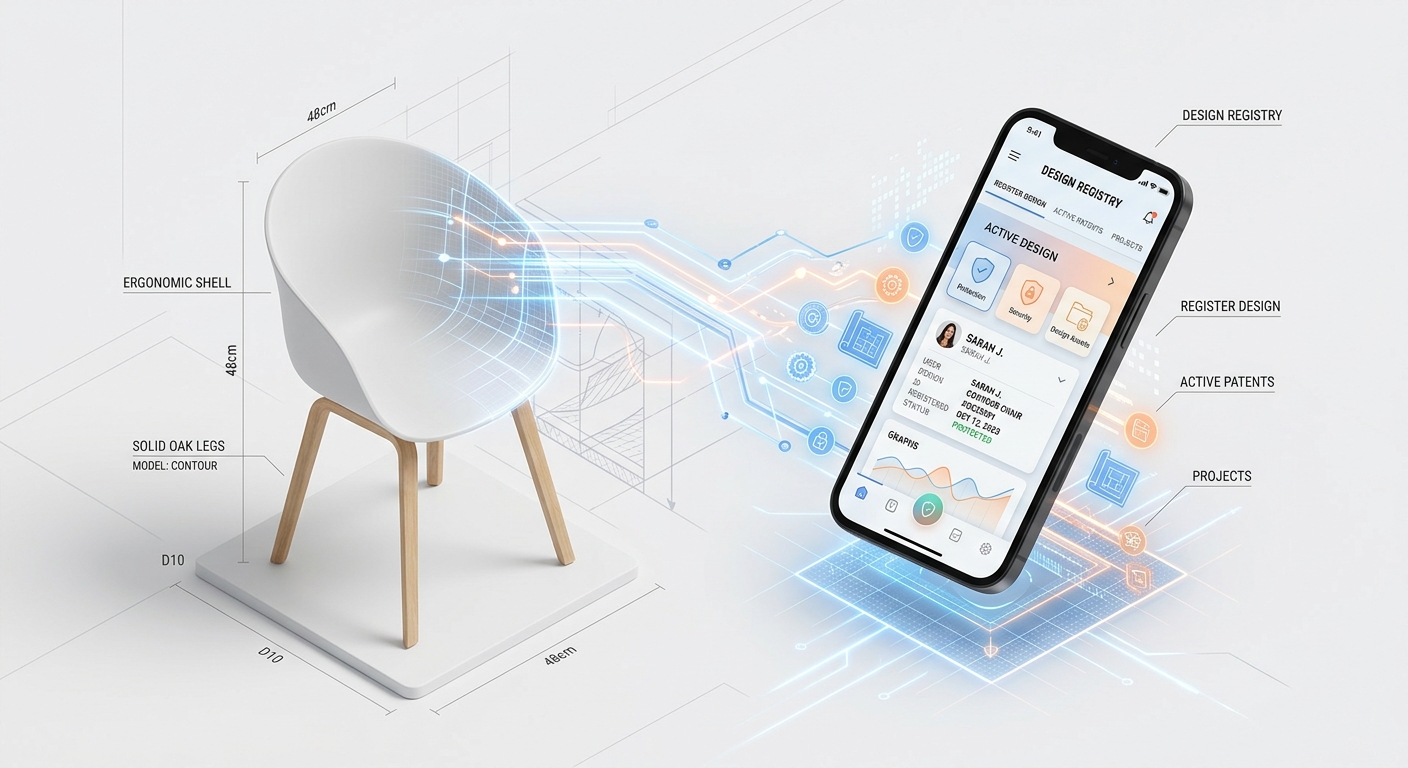
Registration of industrial designs in product design allows you to protect the appearance of the product itself — its shape, lines, colors, and texture. This is critical for furniture designers, packaging creators, and even UI/UX developers. If copyright protects a work as such, a patent gives a monopoly on the commercial use of a specific visual solution, making it an indispensable tool in competitive struggle.
In the modern legal field, the object of protection can be either a physical object, for example, a designer chair for a restaurant, or a virtual one — a set of icons or a graphical interface of a mobile application (GUI). For designers working on complex products, patenting industrial designs becomes a reliable barrier against style copying by competitors, as proving patent infringement in court is significantly easier than looking for signs of plagiarism within copyright.
The specifics of intellectual property protection for designers in this direction lie in the fact that a patent certifies not only authorship but also priority. This means that no one else will be able to register a similar design, even if they developed it in parallel but later than you. Next, we will analyze how to scale this security to the whole world using the advantages of international registration systems.
International Protection of Design Solutions
Entering global markets in 2026 requires creators to abandon chaotic patenting in each country separately. The Hague System for the International Registration of Industrial Designs (managed by WIPO) remains the most economically advantageous tool for scaling. It allows filing a single multilingual application covering over 90 countries, including strategically important markets in the EU, USA, and UK.
The practical experience of our lawyers shows that for successful expansion, a patent for an industrial design alone is not enough. If you are creating a recognizable line of products, a key stage is the timely registration of a trademark for the name of your studio or a specific collection. This creates a double contour of protection: the patent protects the unique shape of the product from copying, and the TM protects the reputation and prohibits competitors from using similar names to imitate your brand on international marketplaces.
Checklist for International Protection Strategy (Hague Protocol 2026)
- Using deferment of publication: In this technique, we recommend declaring a deferment of publication of the design (up to 30 months in many jurisdictions). This allows keeping the design secret until the official release at an exhibition or in online stores, preventing the “leak” of the idea to counterfeit manufacturers.
- Priority rule: Use the 6-month window after filing a Ukrainian application to expand protection to the world. This allows testing demand in the local market before investing in global protection.
- Grouping by Locarno class: For illustrators creating icon sets and furniture designers, it is advantageous to combine up to 100 objects into one international application (provided they belong to the same class).
Real case: One of our clients, a designer lighting developer, faced an attempt to copy his chandeliers by a factory in Southeast Asia even before sales began. Because the application via the Hague System was filed two months before the publication of photos on Instagram, we managed to block the violators’ pages on major trading platforms, relying on the date of international priority. Without formal registration, proving the fact of design “theft” at the international level would have been almost impossible due to the lack of a unified copyright registry on a global scale.
Thus, intellectual property protection for designers and illustrators turns from a legal formality into a risk management tool. Combining the patenting of visual form and the registration of brand names ensures a monopoly that cannot be bypassed by simply changing colors or minor graphic editing.
Disclaimer: This material is prepared for informational purposes and is not legal advice. International registration procedures and requirements of national patent offices may change depending on the geopolitical situation and legislative updates.
The Future Secured: Your Action Plan for 2026
Intellectual property (IP) for a designer is not just a legal formality, but a tool for capitalization. According to current clarifications by UANIPI, legal protection must be comprehensive: from copyright on a sketch to patenting an industrial design on a finished product. This allows turning creativity into a liquid asset, protected from copying by AI algorithms and unscrupulous competitors.
| Action | Goal | Result |
|---|---|---|
| Asset Audit | Identifying commercially attractive characters and patterns | Priority registration plan before publication |
| Trademark registration | Protecting the studio name, logo, or author project | Market monopoly, right to .ua domain, and protection from patent trolls |
| Registry monitoring | Control over newly filed applications | Timely blocking of similar competitor TMs |
For creators developing online sales, it is critical to know how to protect a store name from copying. The question of whether you need to register an Instagram store name or a YouTube channel as a brand is decided in favor of registration, as digital platforms require certificates for account verification. Furthermore, TM registration for obtaining a .ua domain is becoming a standard for designers who strive to establish themselves in the premium market.
Practical case: One of our clients (a furniture designer for HoReCa) created a unique series of chairs for a Kyiv establishment. Without proper fixation of rights, he would not have been able to prevent the replication of these products by other chains. Understanding what trademark registration gives to small business allowed him to pre-register a patent for a cafe or restaurant name (as part of a complex design) in his next project and profitably license his ideas. Additional monitoring of new competitor trademarks helped him timely detect an attempt to register a similar logo and stop it at the application stage.
Important: This material is for informational purposes. To build an effective protection strategy for your specific case, we recommend involving specialized lawyers, as registration procedures in Ukraine and the world may have specific time and procedural nuances.
If you need help with this task, use the trademark registration service.
Frequently Asked Questions
Can I get a .ua domain with only copyright on a logo, without trademark registration?
No, having only copyright on a graphic element does not grant the right to delegate a .ua top-level domain. According to domain zone rules, a mandatory condition is the existence of a valid Ukrainian trademark (TM) certificate, where the verbal part of the TM fully corresponds to the domain name.
If you are a designer or business owner and plan to scale in the Ukrainian segment of the internet, trademark registration is a necessary step not only for protection against copying but also for obtaining a prestigious domain name.
How to protect a unique graphical interface (GUI) of a mobile app from copying by competitors?
Although the app code is protected by copyright, its appearance (icons, element placement, color schemes) is best protected as an industrial design. This allows obtaining a patent specifically for the visual solution of the interface.
For comprehensive protection, it is recommended to:
- Register the most characteristic interface screens as industrial designs.
- Fix authorship on graphic elements through deposit.
- Use combined trademarks for unique button names or services within the app.
Who owns the rights to a design created with AI, and can it be officially registered?
According to updated Ukrainian legislation and global trends of 2026, objects created exclusively by AI without creative human participation are not recognized as objects of copyright in the classical sense. However, a special right (sui generis) is provided for “non-original objects generated by a computer program.”
For commercial use, it is important to:
- Document the “prompting” process and subsequent editing by the designer to prove the presence of human creative contribution.
- Include special clauses regarding the use of AI tools in contracts with clients to avoid claims regarding the purity of rights.
What to do if someone else is trying to claim my Instagram store or YouTube channel name?
Social networks and video hosting sites usually side with the party that has an official brand registration document. If a competitor uses your name, you can file a complaint (DMCA or internal platform forms), attaching a copy of the TM registration certificate.
Without trademark registration, proving your priority right to an account name is extremely difficult, as platform tech support does not consider “publication history” as irrefutable proof of brand ownership.
How to protect a brand from “patent trolls” who register others’ names to extort money?
The best strategy is preventive registration. “Patent trolls” hunt for successful businesses that did not file a TM application in time. If you have already encountered this problem, there are mechanisms for judicial appeal:
- Proving “bad faith” when the troll filed the application.
- Canceling registration due to non-use of the trademark for 5 years.
- Using the right of “prior use” if you started using the name before the troll’s application was filed.
However, court proceedings are long and expensive, so early registration is always more economically advantageous.
What is the difference between transferring rights (alienation) and granting a license to a client?
This is a key nuance in contracts for illustrators and designers:
- Alienation of rights means that you forever transfer all rights to the client. You lose the right to sell this work to others or use it in any way other than what is permitted by law (e.g., in a portfolio, if explicitly stipulated).
- License is permission to use. You remain the owner, but allow the client to use the design in a certain way (e.g., only within Ukraine or for 2 years).
Experts recommend that designers always retain the right to use works for self-promotion and clearly limit the spheres of use in license agreements.
