Nice Classification: How the Alphabetical List Saves You Money
Trademark registration often turns into unpredictable expenses due to the incorrect selection of goods and services categories. In this article, I will explain how to intelligently choose the necessary classifiers to protect your business without unnecessary overpayments, starting with the basics of the system.
Nice Classification Basics: What It Is and Why It Matters
For small businesses, proper classification is the foundation of legal security. We will examine the general structure of the international list and analyze in detail the differences between categories of goods and services, starting with the logic of their construction.
Classifier Structure for Beginners
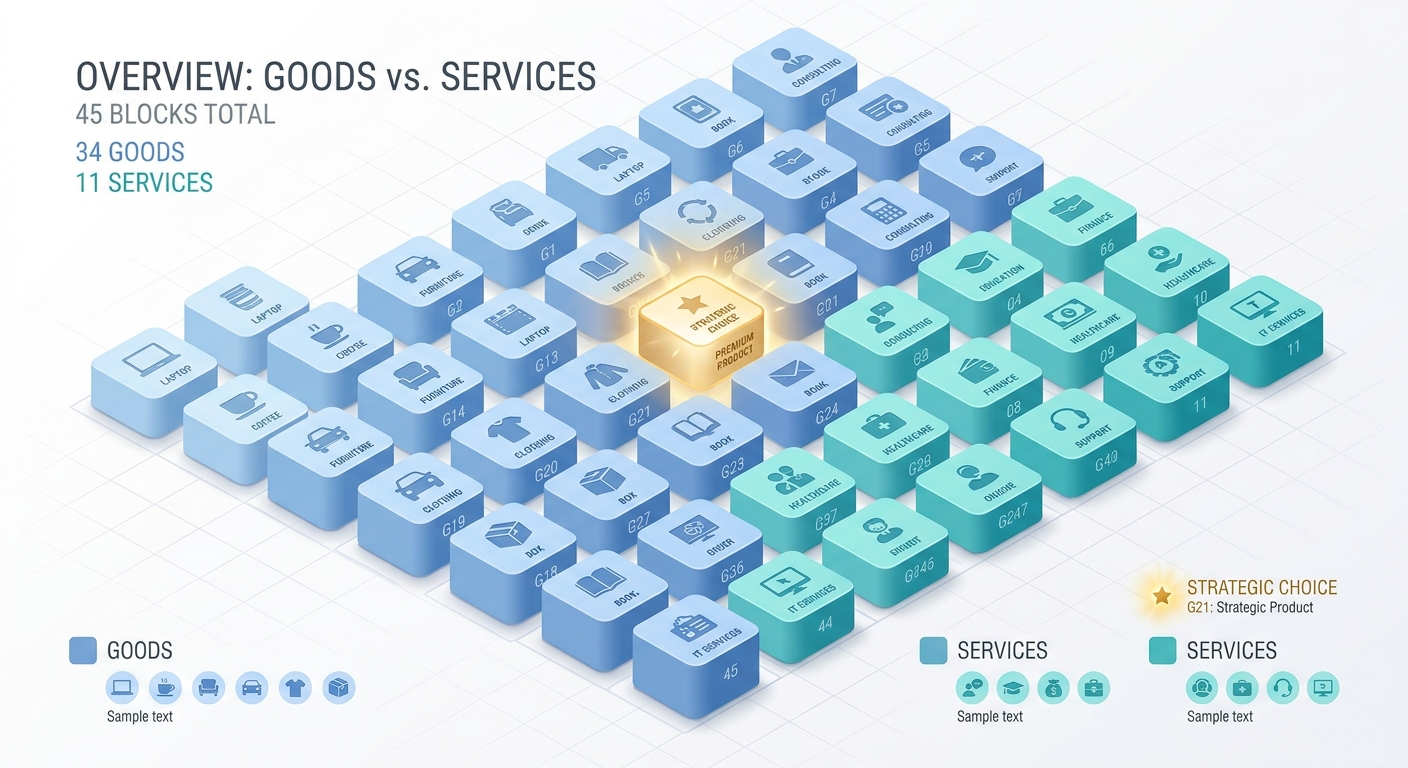
The international system divides all products into 45 categories: the first 34 cover tangible goods, and the remaining 11 cover services. Each item in the list has clear boundaries, and trying to “capture” as much territory as possible without a real need only inflates the application budget. Moreover, excessive appetite often becomes a reason for refusal, as experts may see a conflict with brands you haven’t even heard of.
A smart strategy involves choosing only those areas where you actually operate or plan to launch in the near future. This is critical for what trademark registration gives a small business in terms of legal security. For example, when looking for a way to protect a store name from copying, you shouldn’t register everything in sight—it is better to focus on key positions that match your assortment.
To avoid mistakes at the start, professional trademark registration with expert support allows you to accurately determine the scope of protection. Choosing specific categories in the classifier creates targeted protection that is much easier to defend in disputes with competitors or patent trolls. Next, we will analyze in detail one of the most complex aspects of selection—the difference between Class 35 and direct product categories.
This aspect is covered in more detail in a separate article What Trademark Registration Gives a Small Business: From Security to Profit.
Comparison: Class 35 vs. Product Classes
Understanding the difference between manufacturing a product and services for its sale is the foundation upon which your brand’s security rests. When we analyze Nice Classification classes, a dilemma often arises: is it enough to register the name only for the goods you create, or do you need to capture the sphere of trade as well? The answer depends on how the client interacts with your business.
Take a local clothing brand as an example. If you only sew items under your own name, your “home” will be Class 25. However, if you open a store (online or offline) where accessories from other designers lie next to your own hoodies, you critically need Class 35—retail services. This is especially important if you plan to scale, as a correctly chosen category is a direct prerequisite for the possibility of registering a name for a .ua domain in the future without the risk of refusal due to non-compliance with activities.
| Criterion | Product Classes (e.g., 25, 30, 33) | Class 35 (Trade and Marketing) |
|---|---|---|
| What are we protecting? | Directly the physical product (clothing, coffee, wine). | Services for organizing sales, advertising, management. |
| For whom? | For manufacturers and those who order production under their own brand. | For stores, marketplaces, distributors, and showrooms. |
| Main risk | A competitor can open a store with your name. | You will not be able to prevent others from releasing goods with the same name. |
At Brandr, we always advise clients to look one step ahead: if you plan not only production but also the creation of a trading platform, Class 35 becomes a mandatory addition to product categories. This logically leads us to the next important question: where is the line between reasonable protection and excessive waste?
The ‘Wide Coverage’ Trap: Why More Doesn’t Mean Better
The desire to capture as many categories as possible often plays a cruel joke on entrepreneurs. Let’s look at why excessive appetites turn brand protection into a financial burden and create unnecessary legal obstacles on the way to a certificate.
Financial Mathematics of TM Registration
When it comes to the budget for intellectual property, it is worth remembering: state fees for filing an application have a cumulative effect. The system is built in such a way that each added category in the international classifier increases the final amount you pay to the state. This makes financial planning not just a technical task, but a strategic choice of priorities.
For a small business, the ideal formula is to concentrate on the main activity. Registration in one, most relevant class is the base that guarantees trademark protection and business stability at minimal cost. Each subsequent position should be viewed as an investment: if you do not plan to actually work in this direction in the near future, overpaying for a “pretty list” will simply be a wasted resource.
It should be taken into account that official fees grow in proportion to the number of chosen directions, and this is only the initial stage of expenses. However, financial losses are just the tip of the iceberg, as there are also strict requirements for the actual use of each declared position.
Risk of Cancellation Due to Non-Use
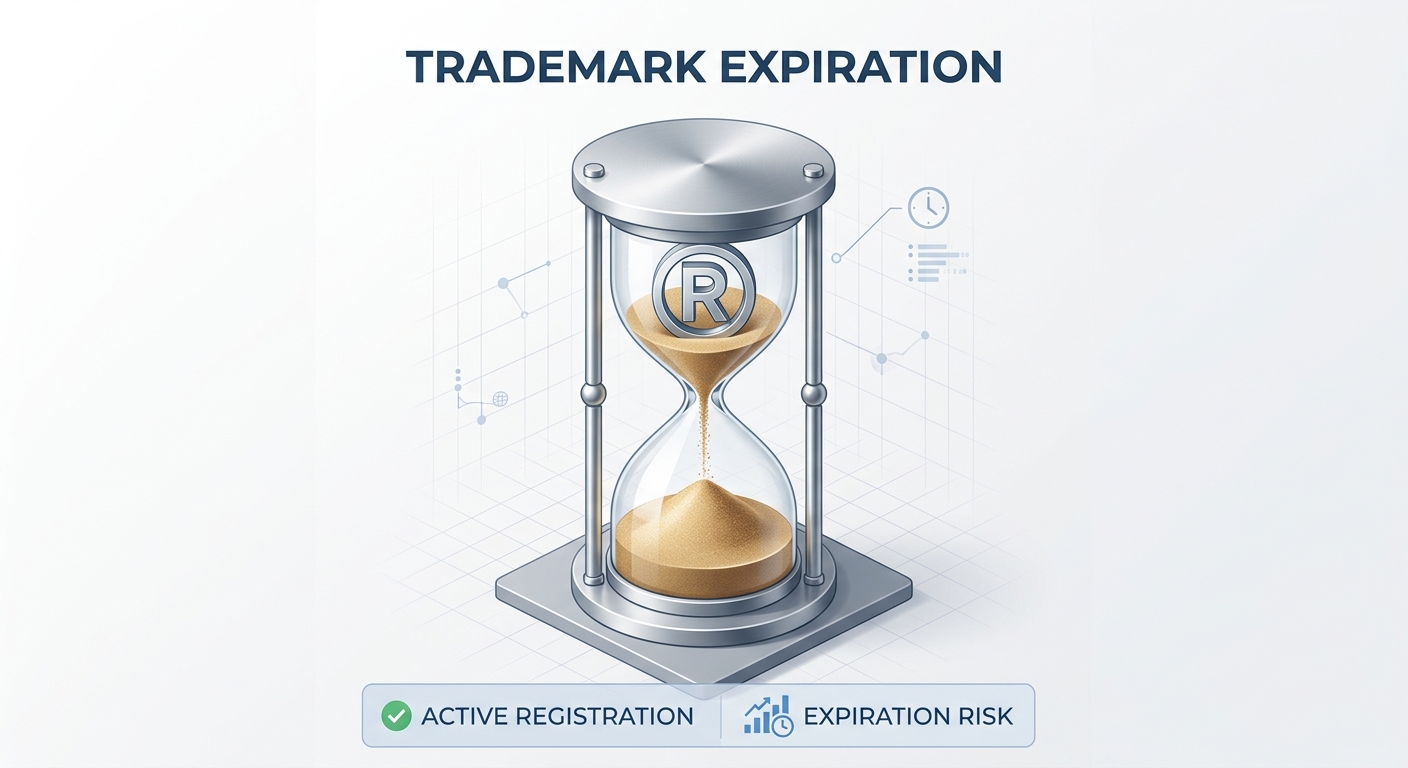
Registering a TM “just in case” in dozens of categories creates an illusion of security that can crumble in court. The legal logic is simple: ownership of a brand is not only a privilege but also an obligation to actually use it for labeling goods or services. If you occupy unnecessary niches, you not only overpay at the start but also become a potential target for challenging your rights through the “non-use” mechanism.
Expert Insight: According to the Law of Ukraine “On the Protection of Rights to Trademarks for Goods and Services” (Art. 18), if a mark is not used in a certain category within a set period (usually 3-5 years), any interested person can initiate a full or partial cancellation of the certificate. This is a standard tool used by competitors to “bite off” a part of your protection in adjacent niches.
In practice, this means that your brand protection against patent trolls becomes vulnerable if you cannot confirm activity with documents. For example, one of our clients (a local clothing brand) registered a TM additionally in the cosmetics class, hoping for a future launch of a perfume line. After 3 years, a competitor planning to enter the market filed a lawsuit to cancel the protection in this class. The client could not provide receipts or contracts for the sale of perfumes, and the right to the name in this category was lost along with the money spent on fees.
| Usage Sign | Evidence Base (Checklist) |
|---|---|
| Direct sale | Invoices, receipts with the TM name, supply contracts. |
| Digital presence | Screenshots of the site in the .ua domain, advertising on Instagram/YouTube where the brand appears. |
| Marketing | Photos of cafe signs, product catalogs, certificates of participation in exhibitions. |
That is why strategic trademark registration should be based on a real business plan, not on the desire to “stake out everything.” Monitoring new trademarks of competitors often reveals such weak points: the owner pays for 10 Nice Classification classes but actually works in one, which makes their portfolio vulnerable to legal attacks.
Note: The material is for informational purposes. The assessment of cancellation risks depends on the circumstances of the specific case and current judicial practice.
When the risks of excessive coverage are understood, it is important to understand what trademark registration gives a small business at each stage of growth to find the right balance between protection and savings.
Selection Strategy: How to Choose Your Minimum
A smart strategy for choosing categories is based on a combination of current income and ambitions. We will look at how to highlight the key areas of your work and look into the brand’s future for several years ahead.
Analysis of Current Business Activity
You need to start selecting categories with a cold calculation: where does your money lie? Small businesses often try to cover everything, but a professional approach requires a focus on activities that generate profit (“Money Making”). Understanding what the registration of your own trademark gives helps to realize: you need to protect the foundation, not the roof that doesn’t exist yet.
To accurately determine your minimum, go through this simple algorithm for finding key categories in the classifier:
- Make a list of real goods and services: Write down everything you sell or provide right now.
- Highlight the “profit core”: Mark the positions that bring in 80% of the income. For example, if you are a designer and only occasionally print postcards, your main protection is design services, not printing.
- Find relevant keywords: Use terms from your list to search in the current edition of the international classifier.
- Check adjacent areas: If you have an Instagram store, protection of trade and advertising services will be mandatory to secure yourself against copying the platform’s name.
Such an analysis helps ensure reliable intellectual property protection for designers and illustrators, craft manufacturers, or owners of small services without unnecessary expenses for related goods. You register only what really works for your capital. Having determined the current basis, it is worth thinking about how strong it should be for future growth.
Forecasting Development for 3-5 Years
A business that works as a cozy coffee shop today can turn into a chain with its own delivery, a mobile app, and a line of branded merch in a few years. If you limit yourself only to catering services at the start, you risk finding out during scaling that the name of your delivery service is already taken by someone or “staked out” by a patent troll. Forecasting development for 3–5 years is a search for the golden mean between saving “here and now” and protecting future profits.
The Money Making strategy we discussed earlier involves protecting 80% of your current income. However, the next 20% is your growth potential. To avoid overpaying for unnecessary Nice Classification classes, it is worth assessing the likelihood of launching adjacent areas. For example, for an Instagram store, it is critical to understand whether it will remain just a platform for resale (Class 35) or plans to release goods under its own brand (relevant product classes). Such planning creates infrastructure advantages: you prepare the ground in advance for entering offline retail or launching a franchise, where having broad TM protection is a mandatory condition.
| Current Business | Development Vector (3–5 years) | Additional Categories for Analysis |
|---|---|---|
| Cafe or restaurant | Own delivery, sale of branded coffee | 39 (delivery), 30 (coffee beans) |
| Design studio | Educational courses, sale of templates | 41 (education), 9 (digital goods) |
| Cosmetics production | Opening a chain of beauty salons | 44 (hygienic and cosmetic care) |
Legal consultations at the stage of choosing categories help build a roadmap for brand protection. Instead of chaotically filing applications for everything, we analyze the risks of infringing on the rights of third parties in adjacent niches. This allows you to lay a solid foundation for scaling, avoiding situations where in three years you will have to conduct a painful rebranding of a new direction due to a conflict with someone else’s trademark. A correctly chosen set of categories today is your insurance against lawsuits and competitor claims in the future.
How this looks in practice is best demonstrated by the case of a coffee shop, where we will compare two scenarios: emotional choice and professional calculation.
Case: ‘CoffeeGo’ Coffee Shop — Mistakes and Solutions
Using the example of a coffee shop, we will analyze two opposite approaches to document preparation. You will see how a chaotic set of categories creates holes in the budget, while a focused strategy provides a reliable legal foundation.
Scenario A: Chaotic Choice of 5 Classes
The owner of a small local coffee shop decided to prepare the documents independently, guided by the logic of “protecting everything I see.” Since the establishment sold coffee, desserts, paper cups, and planned to print logos on t-shirts for staff, five different categories ended up in the application. This approach seemed logical, as on paper the brand received maximum coverage in all possible areas of activity.
However, in practice, this scenario turned into a financial trap. Each added category automatically increases the state fee paid during filing. As a result, the registration budget increased several times compared to the minimum necessary set. In addition to direct expenses, hidden legal risks arose: due to such a “blurred” list, the UKRNOIVI can send requests for clarification of the product specification, which requires qualified preparation of responses and additional time. Moreover, a significant part of these categories was not actually used—for example, t-shirts were sewn only for waiters, not for sale, which creates vulnerability to future lawsuits about cancellation due to passivity.
Instead of real security, the business received excessive expenses and a TM that is easy to challenge in parts where activity is not actually conducted. The next scenario will show how the same task could have been solved three times cheaper and ten times more reliably.
Scenario B: Optimization for Real Needs
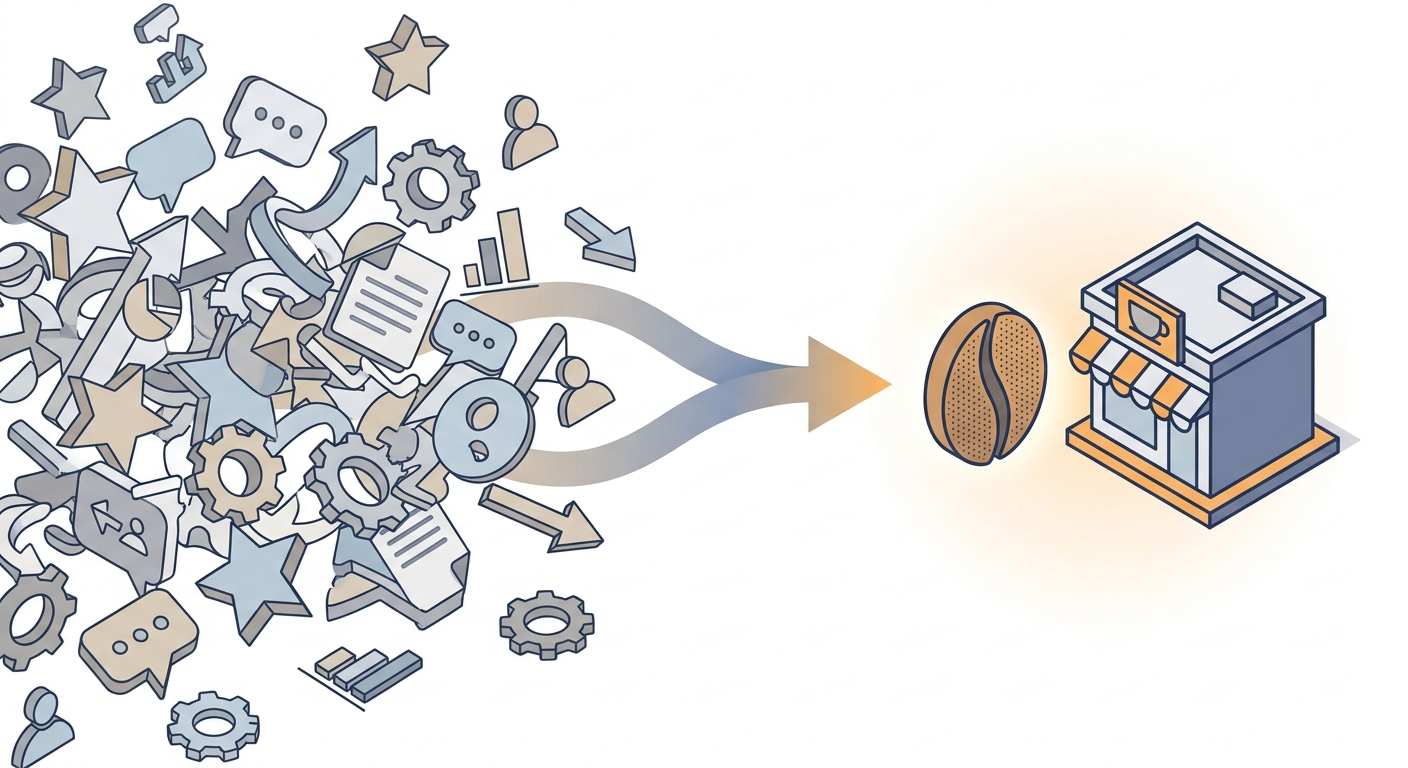
In Scenario B, we transform our client’s approach from emotional to strategic. Instead of trying to cover everything, Brandr specialists highlighted two priority areas: catering services (Class 43) and coffee production (Class 30). This not only ensures legal purity but also eliminates the risk of certificate cancellation due to three years of non-use (according to Art. 18 of the Law of Ukraine “On the Protection of Rights to Trademarks for Goods and Services”).
Comparison: Chaos vs. Expertise
| Indicator | Scenario A (5 classes) | Scenario B (2 classes) |
|---|---|---|
| State fees | Base budget (100%) | Savings over 60% |
| Legal stability | Vulnerability due to “empty” classes | Maximum (only real activity) |
| Scalability | Blocked by unnecessary expenses | Ready for franchise and .UA |
Thanks to this decision, professional trademark registration became an asset for the coffee shop, not a burden. This allowed the owner to confidently resolve the issue of how to protect the store name from being copied by competitors on Instagram, where the brand sells its own roasted coffee (Class 30).
Infrastructure advantages of optimization:
- Digital space: Having a certificate in the right class is a mandatory condition for a procedure such as TM registration for obtaining a .ua domain, which increases customer trust.
- Media protection: An optimized list of services provides a legal basis for content moderation if you need to register a YouTube channel name as a brand for a future video blog about coffee culture.
- Security: A selective approach minimizes the attention of patent trolls, as the brand is protected exactly where it earns money.
The correct choice of Nice Classification classes at the planning stage creates a solid foundation for scaling the business without overpayments. When the strategy meets real needs, every paid fee turns into an investment in the security of your name and logo.
Note: Information is current as of the date of publication. To calculate the exact cost of fees in your case, it is recommended to check current tariffs on the UKRNOIVI website.
This aspect is covered in more detail in a separate article TM Registration for Obtaining a .ua Domain: Full Algorithm.
Checklist for Self-Verification Before Filing
For a successful application, it is necessary to finalize the list of goods and services. Next, we will analyze how to filter out unnecessary duplications and in which cases it is worth expanding coverage for additional security.
Final Filter of Your Goods and Services
Before filing an application, it is important to run the formed list through a “sieve” of practical logic to avoid artificial budget inflation. First, check services for “nesting”: for example, within Class 43 (restaurant activity), the process of preparing dishes is usually already covered by general service, so separate wording for each step only duplicates the content. Second, clearly distinguish between trade and production—if you only sell products of other brands, your protection is concentrated in Class 35, and adding product categories will be a mistake.
The third step is to filter out positions for “internal consumption.” Branded notebooks for the office or staff uniforms do not make a business a manufacturer of paper or clothing if these goods are not intended for independent sale. It is also important to eliminate terminological synonyms (like “consulting” and “providing advice”) within one sphere, as this provokes additional requests from UKRNOIVI expertise. Finally, analyze the zones of intersection between design and product manufacturing so that the description of services does not conflict with product groups.
Such an audit demonstrates what trademark registration gives a small business in practice: it is primarily a tool for targeted protection of real profit, not an attempt to cover all possible classes “just in case.” Professional trademark registration always begins with cutting out legal noise, which is the most reliable way to protect a store name from copying without overpaying for unnecessary Nice Classification categories.
When It Is Worth Adding an ‘Extra’ Class
While you are filtering your list of goods, trying to leave only the most necessary, it is worth pausing and looking into the future. Saving on state fees is a rational step, but sometimes an “extra” category becomes not an expense, but a bulletproof vest for your business, especially when it comes to protection against unfair competition.
I highlight several cases when adding an additional class is a justified investment:
- Blocking patent trolls: This is professional brand protection against patent trolls who monitor successful startups and register their names in adjacent categories. If you sell clothing, a troll can register your name for jewelry or perfume just to demand a ransom for “releasing” the name.
- Scaling in the media space: Today, small businesses often start with content. For many projects, timely registration of a YouTube channel name as a brand or protecting a profile name on Instagram becomes critical during monetization. Even if you just bake cakes, a category of entertainment or educational services may be needed for future online courses.
- Infrastructure plans: If your strategy includes plans for a franchise or obtaining a premium domain, expanding the list of services becomes a technical necessity. For example, TM registration for obtaining a .ua domain requires a clear correspondence between the trademark name and the domain name, and having an additional class will protect you from claims in the future.
Such an approach allows you to understand how to protect a store name from copying not only in the “here and now” moment but also taking into account the growth of brand capitalization. The main thing is to find the golden mean between total protection of everything and dangerous vulnerability in adjacent niches, where your strategically chosen Nice Classification classes should become a reliable shield.
Understanding these nuances turns the application process from mechanical form-filling into the creation of a real protective asset.
Investment in Classes is an Investment in Clarity
The correct choice of categories is not just bureaucracy, but the definition of the boundaries of your ownership. The balance between current savings and future security determines whether you will be able to protect a store name from copying when the business starts to scale. For a small entrepreneur, Nice Classification classes are the “authorized capital” of their intellectual property.
| Parameter | Minimalist Choice | Strategic Planning |
|---|---|---|
| Goal | Saving on fees “here and now” | Protection for 3–5 years of development |
| Scope of protection | Only 1 narrow direction | Main type of activity + adjacent niches |
| Scalability | High risk of conflicts in new spheres | Ready foundation for franchise and YouTube channels |
| Legal stability | Vulnerability to trolls in neighboring classes | Maximum brand “armor” |
To understand if one class is enough for you, take a short test:
- Do you plan to go online? If so, to the main class (e.g., 43 for restaurants), it is worth adding 35 for merch or advertising services.
- Will the brand be the basis for training? If you create online courses as an addition to services, protection in Class 41 is critical.
- Do you need a premium domain? Remember that TM registration for obtaining a .ua domain requires full correspondence of the TM name to the domain name, regardless of the chosen classes.
According to the official Nice Classification (IP office), the list of goods and services must be as specific as possible. As our practice shows, one of our clients (a local chain of bakeries) saved their YouTube channel from being blocked only because they added a class for educational services in time. This confirms: professional trademark registration is not an expense, but an investment in the clarity of your rights.
The next logical step should be to conduct a preliminary search. This will allow you to identify similar names before you pay state fees and will ensure a reliable patent for a cafe or restaurant name without unnecessary risks.
Disclaimer: This material is for informational purposes. The scope of legal protection of a TM depends on the correctness of the wording of the list of goods and services. Consider the “3-year rule”: if a TM is not used in a registered class for more than three years, the registration can be canceled at the suit of interested persons.
If you need help with this task, use the service trademark registration.
Frequently Asked Questions
Can I add new classes to an already registered trademark if the business has expanded?
Unfortunately, current legislation does not allow adding new classes or expanding the list of goods and services within an already filed application or registered certificate. If your business has started to master new niches (for example, you produced clothing in Class 25, and now decided to release perfume in Class 3), you will have to file a new application for TM registration.
That is why at the planning stage with Brandr experts, it is important to lay a “safety margin” for the next 3 years. This allows you to avoid repeated expenses for state fees and legal services in the future.
Are Nice Classification classes the same in Ukraine and abroad during international registration?
Yes, the International Classification of Goods and Services (Nice Classification) is a unified system used by over 150 countries that have joined the Nice Agreement. This significantly simplifies life for entrepreneurs: if you have correctly defined the classes in Ukraine, you can use this same list to expand protection through the Madrid System (WIPO).
However, it is worth considering the nuances of national patent offices. For example, in the USA (USPTO), requirements for the specification of goods are much stricter than in Ukraine, and simply copying general class headings can lead to refusal.
What is better: to indicate the entire class heading or to choose specific positions?
For a small business, the optimal strategy is to choose specific goods and services that you are actually engaged in or plan to engage in. Using the full class heading (e.g., all services of Class 35) has its drawbacks:
- Increased risk of conflict with already registered marks in adjacent spheres.
- Higher probability of receiving a refusal from expertise due to blurred wording.
- The trademark is easier to cancel in court for non-use in specific segments that you simply “staked out” without the intention to work.
We recommend formulating the list as clearly as possible so that the protection is “targeted” and legally stable.
How to act if my product falls under several classes simultaneously?
In the modern economy, products are often hybrid. Let’s look at a few examples:
- SaaS solutions: software as a product belongs to Class 9, and providing access to it as a service—to Class 42.
- Restaurant business: service in the establishment is Class 43, but if you sell your own sauces or semi-finished products in supermarkets—these are Classes 29 or 30.
- Bloggers: content creation can cover Class 41 (entertainment) and Class 35 (advertising and promotion).
In such cases, you need to set priorities depending on the budget. The main rule is to protect the class that brings the main profit today, and the one where the risk of copying by competitors is highest.
Does the correct choice of classes help avoid conflicts with giant brands?
Yes, Nice Classification is a tool for legal coexistence. The law allows the existence of two identical names if they are registered in unrelated classes and do not mislead the consumer. For example, the brand “Orbita” can simultaneously exist for the production of metal-plastic windows and for a dental clinic.
However, it is worth being careful with “well-known marks” (e.g., Coca-Cola, Google). Such brands have enhanced protection that often goes beyond registered classes, and an attempt to register a similar name even in a completely different sphere can end in a lawsuit.
What to do if the Nice Classification is updated after I have filed an application?
Nice Classification editions are updated annually (new edition—every 5 years, versions—annually). However, for your trademark, the edition that was current on the date of filing the application will apply. You do not need to re-register the mark or change the wording with each update of the classifier.
Changing editions is important only when extending the validity of the certificate (once every 10 years) or when filing new applications. Brandr service specialists always use the current version of the classifier to avoid technical errors when corresponding with UKRNOIVI.