More Than a Logo: Why a TM Is the Foundation of Your Business
Most entrepreneurs view an official brand certificate as unnecessary bureaucracy until they face name hijacking or sudden ad account bans. I will explain how proper trademark registration turns a vulnerable shop name into a liquid asset.
Franchising for Small Businesses: The Role of a TM in a Contract
Scaling through franchising is legally impossible without official brand status, as a commercial concession agreement is based on the transfer of rights. Below, we examine the TM as the core of a franchise and the risks of operating under “naked” licenses.
The TM as the Legal Core of a Franchise
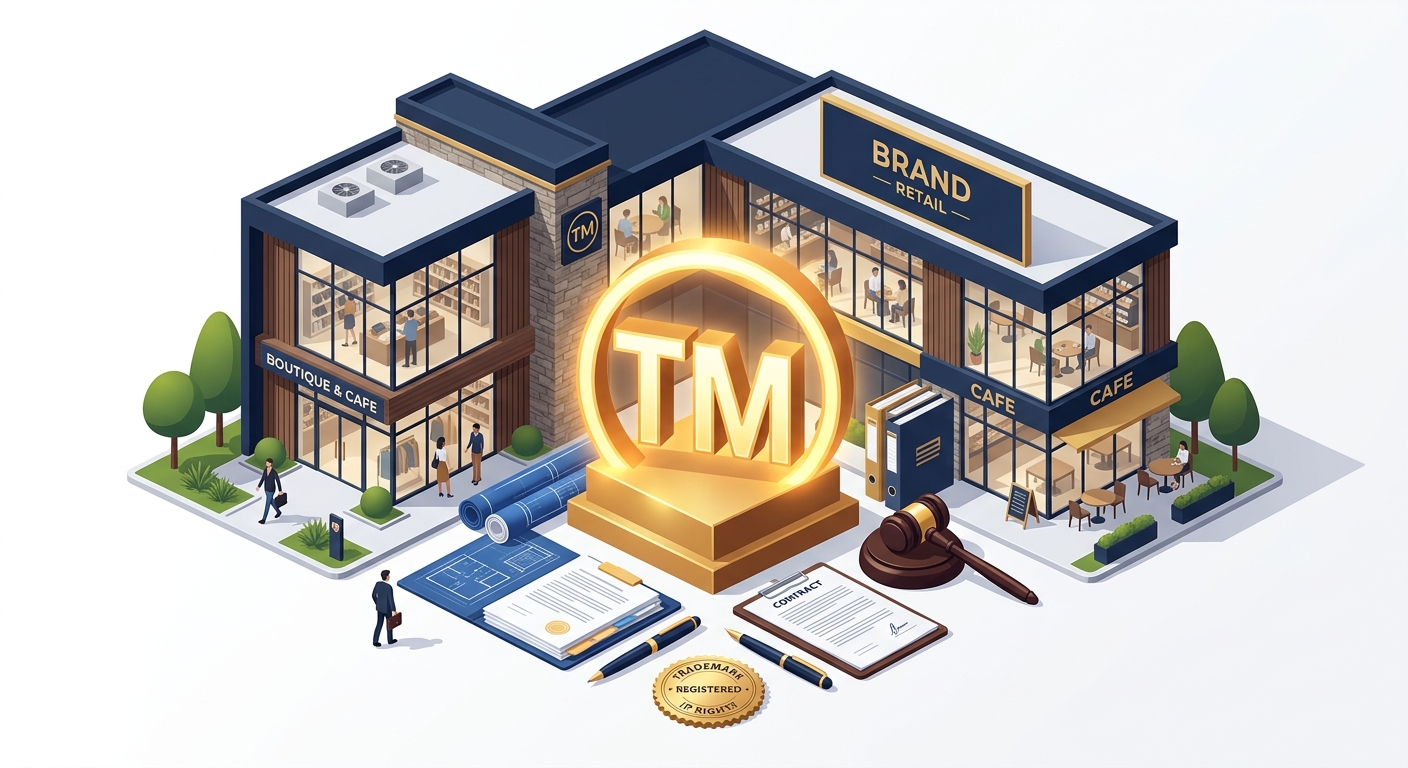
When you sell a franchise, you aren’t just sharing a coffee recipe or a banner layout—you are transferring the right to use your commercial identity. Legally, this is only possible if the name and logo belong to you based on a certificate; otherwise, the contract will have no real force in court. Without a registered mark, you are effectively selling air, which makes the business model vulnerable to claims from partners or regulatory authorities.
Checklist for Preparing a TM for Franchise Sales
- Compliance with Nice Classification: Check if your mark covers not only the production of goods but also business management or consulting services.
- Territory of Operation: Ensure that protection extends to all regions where you plan to open new locations.
- Registration Term: The certificate must be valid for the entire duration of the franchise agreement, including renewal time.
- Rights Assignment from Authors: Have contracts with designers on hand that confirm the transfer of rights to the logo to your company.
- Legal Purity: Monitor new competitor trademarks to ensure your name hasn’t become too similar to others’ later developments.
Your intellectual property becomes the foundation for successful rights transfer, ensuring predictability for both parties. This approach minimizes legal friction and allows you to focus on profit rather than litigation over the right to use your own name.
However, even a perfectly built franchise system can collapse if it is based on a so-called “naked” license.
Risks of “Naked” Licenses Without Registration
Entering into a franchise agreement without an obtained certificate is a classic example of a “naked license.” According to the requirements of the Civil Code of Ukraine (Articles 1108–1109), only the owner of an object can dispose of property rights. If the TM is not registered, the object of the contract is legally non-existent. This turns your business model into “air” that cannot be legally sold or protected in court.
Legal consequences of using an unregistered name in a franchise:
- Voidness of the Transaction: Under Art. 215 of the Civil Code, the contract can be declared invalid because it contradicts civil legislation (no certificate = no right to transfer).
- Recovery of “Unjust Enrichment”: Based on Art. 1212 of the Civil Code, a partner (franchisee) can sue to demand the return of all paid lump-sum fees and royalties, as you were profiting from an object that did not belong to you.
- Loss of Control: You cannot dictate quality standards or prohibit the use of the name after the relationship ends, as the brand is legally “ownerless” until the moment of registration.
Expert Insight: Many entrepreneurs mistakenly believe that having an LLC or sole proprietorship with a certain name gives them the right to franchise. This is not true. When a conflict arises, franchisee partners quickly turn into opponents in court. That is when the realization comes of what trademark registration gives a small business: it is not just a status, but “armor” against lawsuits for investment recovery. Timely trademark registration through an IP office removes these risks right at the start.
Typical mistake: a practical example
One of our retail clients launched a network under a “cooperation” agreement without waiting for the name to be registered. When one of the partners decided to leave the network, they not only kept the signage but also filed a counterclaim. The argument was simple: “I paid for the use of a brand that does not exist in the registry.” As a result, the network owner was forced to return royalties for a year and a half of operation. This is a telling case of how trying to save time on registration leads to a “domino effect” where the entire revenue structure collapses.
Beyond internal risks with partners, an unprotected brand remains vulnerable to external attacks. When deciding how to protect a shop name from copying, remember: without a certificate, you cannot even file an official complaint with a marketplace or social media administration.
This aspect is covered in more detail in a separate article: Franchising for Small Businesses: The Role of a TM in a Contract.
Protecting a TM on Social Media and Marketplaces
A protected brand becomes a key tool for daily operations in the digital environment. We will analyze algorithms for fighting plagiarism and real cases of recovering stolen profiles, turning intellectual property into a true company asset.
Algorithm for Fighting Content Copying

In the digital environment, ownership of a name becomes a technical tool for rapid response to plagiarism. Large platform algorithms operate on formal logic: support services do not investigate who created the profile first, but demand legal proof of rights. Therefore, professional trademark registration is critical for those looking for an effective way to protect a shop name from copying.
Here is a step-by-step algorithm of actions that allows you to effectively fight violators online:
- Fixing the violation. Take full-screen screenshots of the copycat page where the URL, date, and content violating your rights are clearly visible. Use services like Archive.today or the Wayback Machine to create immutable digital copies of pages that can be used as evidence.
- Checking the validity of rights and classes. Ensure your certificate is valid and that the Nice classes cover the violator’s field of activity. You can check the current status via the Special Information System of the Ukrainian National Office for Intellectual Property and Innovations. If you are hesitant about whether you need to register an Instagram shop name, remember: without a match between the classes in the certificate and the violator’s activity, the platform may reject the complaint.
- Collecting a document package for a specific platform. Evidence requirements may vary slightly depending on the site:
| Platform | Data required for complaint |
|---|---|
| Social Media (FB / Instagram) | Certificate number, link to the state registry, clear description of content imitating your brand. |
| Amazon (Brand Registry) | TM registration number, photos of goods or packaging with the logo, confirmation of active protection status. |
| Google / YouTube | Legal name of the owner, violator’s URL, explanation of how the use of the TM misleads users. |
- Filing an official complaint (Takedown Notice). Fill out the form in the intellectual property center of the respective platform. Write concisely, referring to specific points of the community rules regarding Trademark Infringement. Use the platform’s terminology — this speeds up automated and manual request processing.
- Monitoring results and appeal. Review usually takes from 48 hours to a week. If the violator files a “counter-notification” claiming they have the right to the name, be prepared to provide a copy of a license agreement or confirmation of initiated legal proceedings.
It is in conflict situations that it becomes obvious what trademark registration gives a small business: it turns the brand into an asset that cannot be copied with impunity. However, sometimes competitors try not just to copy content but to take over the profile entirely — in the next section, we will look at a case of recovering a stolen account using a certificate.
Disclaimer: This material is purely informational. Marketplace requirements and legal procedures may change. To protect your rights, we recommend seeking individual consultation with specialists.
Case: Stolen Profile vs. Certificate
When you understand the mechanics of filing complaints, it is important to see how these tools work in real “field” conditions. In practice, having documentary proof of rights turns exhausting correspondence with social media support into a fast and effective procedure that saves your nerves and client base.
“Before and After” Scenario: Battle for the Reputation of a Cosmetic Brand
“Before” Situation: One of our clients, a small manufacturer of natural cosmetics, was actively developing an Instagram page. A competitor created an identical profile: they copied photos, texts, and even the name of the cream line, starting to intercept orders. Since the brand was not legally protected, Meta rejected the owner’s complaints, citing “insufficient evidence of authorship.” The business was losing money and customer loyalty for a month.
“After” Situation: With a Certificate in hand, lawyers filed a request through the official intellectual property rights violation complaint form. Because the legal foundation had been laid in advance, the fake clone page was blocked within 48 hours. This is a clear example of this option in the context of rapid response to digital hijacking.
Beyond instantly blocking clones, a Certificate opens the door to building serious digital infrastructure. For example, obtaining a .ua domain is impossible without an officially registered brand, and such an address online commands the highest level of trust from Google and buyers. However, security is only one side of the coin, as a properly registered brand can turn from an expense into a powerful financial asset.
It is this transition from a defensive function to a profitable one that makes intellectual property the best investment, which we will analyze through asset valuation.
This aspect is covered in more detail in a separate article: Trademark Registration for Obtaining a .ua Domain: A Complete Algorithm.
TM Valuation: Turning a Name into an Asset
Once protection is set up, it is time to look at the brand as a financial instrument. A TM can generate profit directly, becoming part of the company’s capital and opening the way to strategic capitalization and maneuvers.
TM in Business Accounting
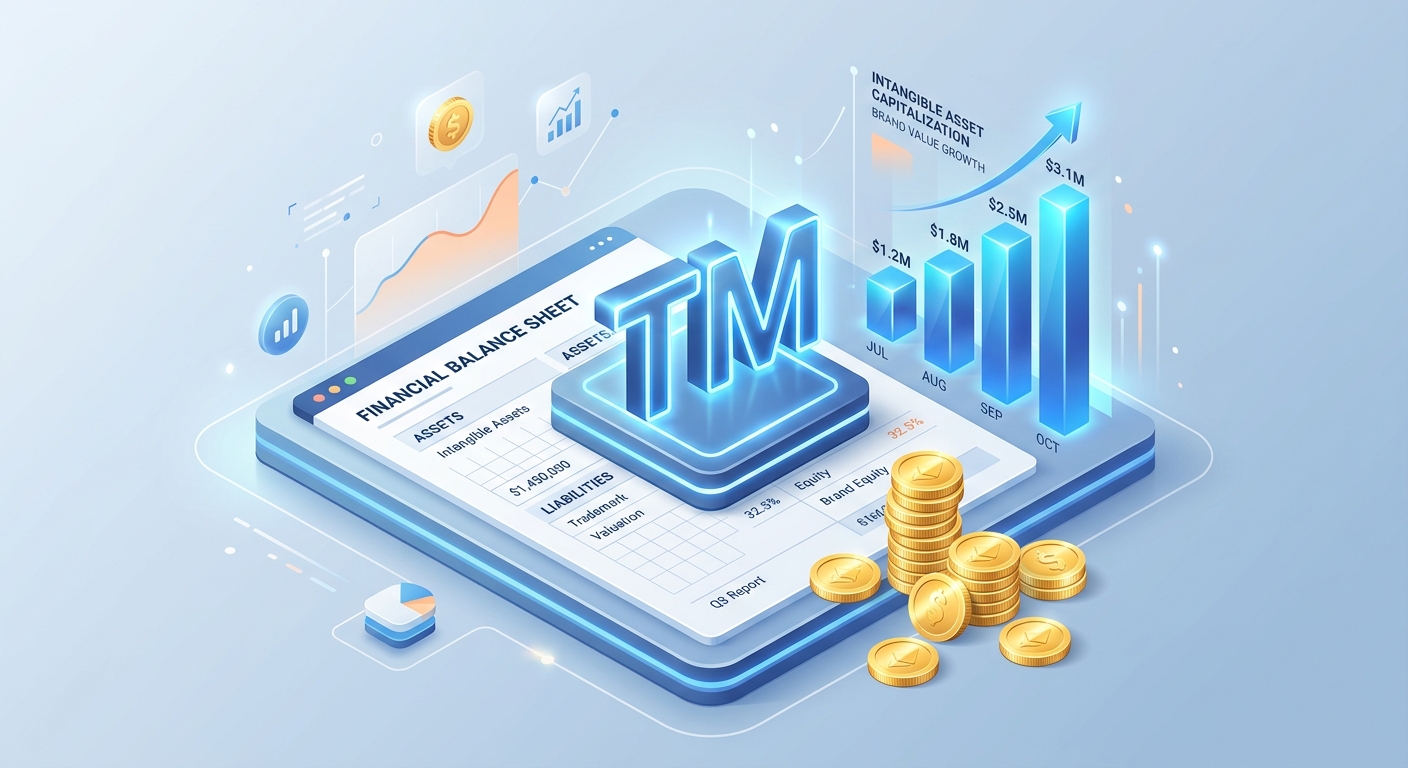
In accounting, a trademark (TM) is classified as an intangible asset. This fundamentally changes the company’s financial structure because, unlike equipment or inventory, a brand has fundamentally different economic characteristics. Understanding this solution in financial terms allows the owner to turn marketing efforts into a capitalized asset.
Compared to tangible assets, a TM offers three key financial advantages:
- No physical wear and tear: Any equipment eventually becomes obsolete and loses value. A trademark is not subject to physical wear and tear — on the contrary, its market price usually grows over the years due to the accumulation of reputational capital.
- Flexibility in collateral: Unlike machinery or goods, which require storage and security costs, a TM can be an object of collateral (IP-backed lending). This allows you to attract credit funds under the brand’s “name” without restricting the operational activity of production lines.
- Goodwill formation: Tangible assets are valued at residual value when sold. A TM forms goodwill — additional market value of the company, which, upon exit or franchise sale, can exceed the sum of all physical resources of the enterprise several times over.
For a name to become a full-fledged financial instrument, official trademark registration is necessary. The certificate itself is the basis for putting the object on the balance sheet and subsequent amortization. Furthermore, the correct choice of Nice classes at the application stage ensures that the asset will be correctly classified in reports and protected in the exact niches where the business generates the main profit.
This aspect is covered in more detail in a separate article: Choosing Nice Classes for Small Businesses: How Not to Overpay.
Brand Monetization via License Payments
Obtaining a certificate for goods and services opens the possibility of turning an intangible asset into a real cash flow through the royalty mechanism. For a small business owner, this is one of the most effective ways of legal tax planning and profit withdrawal. When a trademark is registered to the founder as an individual, they can grant the right to use it to their company (LLC) based on a license agreement, receiving monthly payments for every product sold or service provided.
From a financial perspective, license payments are classified as gross business expenses, which legally reduces the corporate income tax base. For the owner, royalties are often taxed at more favorable rates than dividends or salary. In my practice, we often develop such schemes for businesses planning to scale: this allows the owner to retain control over the brand even if the LLC’s membership changes. If you are considering such a tool, it is worth considering market royalty rates, which usually appear in such deals:
| Business Industry | Typical Royalty Rate (% of turnover) | Accrual Features |
|---|---|---|
| Retail and HoReCa | 3% – 6% | Depends on local brand recognition |
| Consumer Goods Manufacturing | 2% – 5% | Calculated on the volume of shipped products |
| Services and Consulting | 5% – 10% | Higher rate due to the large share of intellectual component |
| Software and IT | 10% – 25% | For the use of unique algorithms and interfaces |
Passive income from your own brand becomes possible only with a legally flawless certificate. Without an official patent for the name of a cafe or restaurant, the tax service may deem any royalty payments as fictitious transactions, leading to fines and additional charges. Therefore, registration is not just protection against copying, but the creation of a legal foundation for financial maneuvers that were previously available only to large corporations. This approach makes your asset liquid: in case of selling the business, you can sell the operating company but keep the rights to the brand, continuing to receive profit from the new owners.
Understanding these financial benefits finally changes the perception of a mark from a “pretty picture” to a full-fledged insurance policy and a ticket to big business.
If you need help with this task, use the service: trademark registration.
A Trademark Is Your Insurance Policy and Ticket to Big Business
Your own brand is not just a visual style, but your foundation for scaling, guaranteeing the legal purity of a franchise, security on social media, and stable financial growth. Understanding what trademark registration gives a small business allows you to turn a name into a protected asset that brings in royalties and protects against patent trolls. Delaying the registration of rights usually costs significantly more than the procedure itself, so do not wait for competitor claims — contact me and the Brandr team for an audit and registration right now. This is your insurance policy that turns a startup into a serious business with capitalization.
Frequently Asked Questions
What are Nice classes and why can a mistake in choosing them make registration useless?
Nice Classification (International Classification of Goods and Services) is a list of 45 classes that define the boundaries of your trademark’s protection. A trademark protects a name not “in general,” but only within the chosen areas of activity.
Why the right choice is critically important:
- Risk of lack of protection: If you registered a TM for “clothing” (Class 25) but started selling “perfume” (Class 3) under the same name, competitors can legally use your name in the cosmetic sphere.
- Expansion costs: It is impossible to add new classes to an existing certificate. If the business scales, you will have to file a new application and pay state fees again.
- Patent trolls: They often register well-known names in related classes that the owner forgot to cover, only to demand a ransom for the brand later.
Experts recommend registering a TM “with a margin” for areas your business plans to enter in the next 2–3 years.
Does a Ukrainian TM certificate protect my brand when entering the international market?
No, intellectual property protection is territorial in nature. A certificate issued by the Ukrainian National Office for Intellectual Property and Innovations is valid exclusively within the territory of Ukraine.
There are two main ways to protect a brand abroad:
- Madrid System: Allows you to file one international application through the Ukrainian office, specifying a list of countries (over 120) where you want to obtain protection. This is significantly cheaper than filing separate applications in each country.
- National Procedure: Direct application to the patent office of a specific country (e.g., USPTO in the USA or EUIPO in the EU). This is advisable if you are interested in only one specific market.
It is important to start international registration as early as possible, as many markets operate on a “first-to-file” principle, and competitors may beat you to it.
How to protect a YouTube channel or blog name through TM registration?
For creators and bloggers, the channel name is their main capital. TM registration for media projects provides protection against the creation of fake accounts and the use of your “name” for advertising third-party goods.
When registering a channel name, it is important to cover the following classes:
- Class 38: Telecommunications and streaming (broadcasting on the Internet).
- Class 41: Entertainment, video content creation, educational activities.
- Class 35: Advertising and promotion of third-party goods (relevant for advertising integrations).
Having a TM certificate allows you to file complaints through the Content ID system and internal platform tools (YouTube, TikTok, Facebook) to remove content that violates your brand rights.
Who are “patent trolls” and how does having your own TM save you from their claims?
Patent trolls are individuals or companies that register popular names, logos, or domains that entrepreneurs are already using but haven’t yet legally formalized. The goal of trolls is not to develop a business, but to demand monetary compensation or a buyout of rights from the real owner.
Your own TM registration works as a preventive shield:
- It creates priority: whoever files the application first has the superior right to the name.
- It allows you to cancel troll registrations if you can prove the “bad faith” of their actions or your use of the name before their application.
- It allows you to instantly block any attempts by trolls to interfere with your import or export of goods through the customs registry.
The best protection against trolling is filing a TM registration application at the product launch or branding development stage.
How long is a trademark valid and how do you not lose it?
A trademark certificate in Ukraine is valid for 10 years from the date of application. Unlike patents for inventions, this term can be renewed an unlimited number of times — each time for another 10 years.
To not lose the right to a brand, you need to:
- Pay the renewal fee on time: The renewal application must be filed during the last year of the certificate’s validity.
- Use the TM: If a mark is not used for 5 consecutive years, any interested person can apply to the court with a demand for early termination of the certificate.
- Monitor registries: Ensure that competitors do not register similar names and file oppositions in time before they are issued a certificate.
Can I get a .ua domain without official trademark registration?
No, obtaining a second-level domain name in the .ua zone (e.g., brand.ua) without a registered trademark is impossible. This is a mandatory requirement of the Domain Registration Regulations established by the .UA zone administrator.
Key nuances to consider:
- The domain name must fully correspond to the verbal part of your TM (in Latin letters).
- To register, you must provide the number of the TM registration certificate in Ukraine.
- International trademarks that have an extension to the territory of Ukraine under the Madrid System also grant the right to obtain such a domain.
This makes the .ua domain one of the most protected and prestigious, as it automatically confirms the reliability of the business and its possession of intellectual property.