The .ua Domain as an Asset: Why You Can’t Do Without a TM
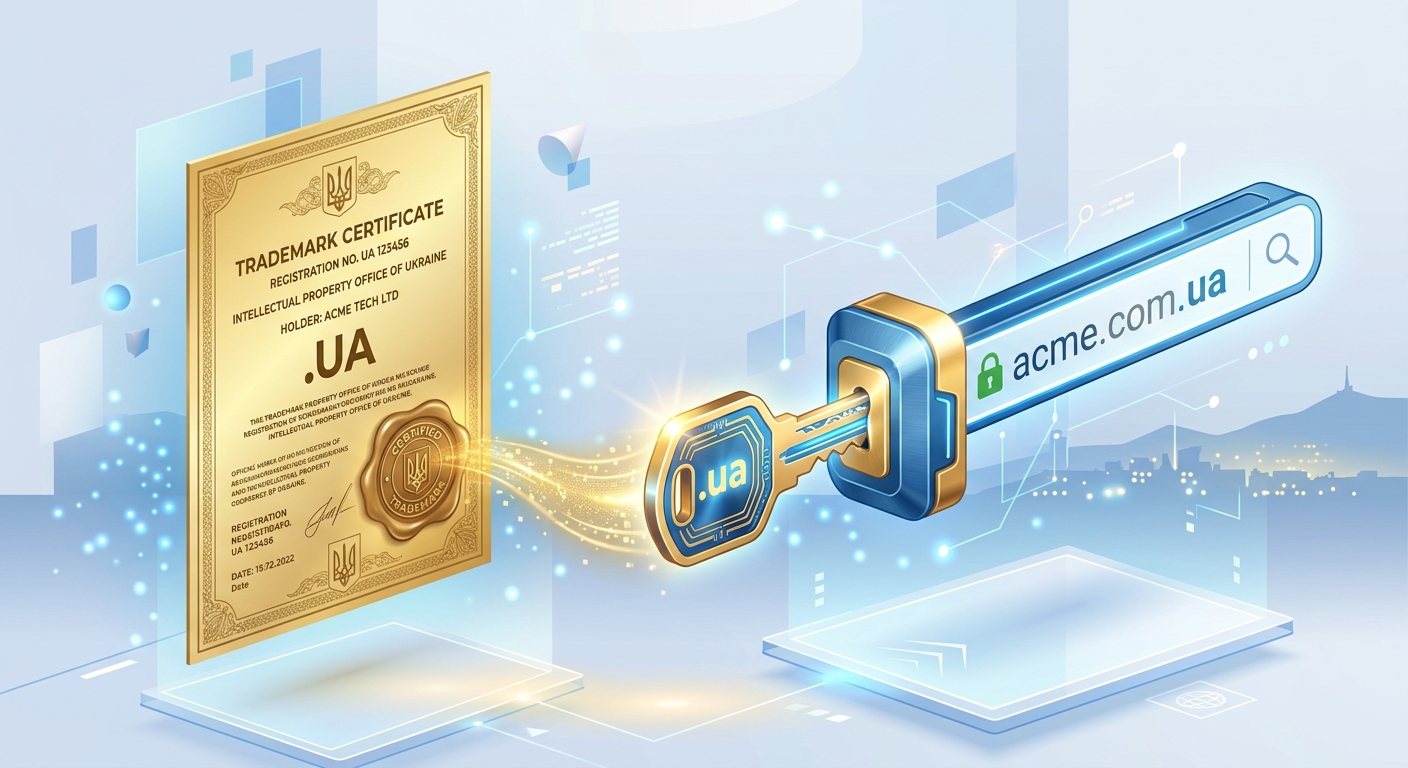
Obtaining a prestigious .ua domain is a real challenge for many companies due to strict regulations that recognize only holders of official certificates for goods and services marks. We will look at how to properly prepare documents so that your intellectual property becomes a gateway to an elite digital address, providing infrastructure advantages for business scaling. Below, we examine the legal link between a TM and a domain.
The Legal Link Between a TM and a Domain
For many entrepreneurs, registering a TM to obtain a .ua domain is the first step toward building a serious digital asset protected from third-party infringement. Next, we will compare different domain zones and examine critical requirements for the identity of the future brand name, which determine the success of name delegation on the network.
Why .com.ua Won’t Replace .ua
Business owners often believe that an address in the .com.ua zone is sufficient for a start, but in terms of brand capitalization, this is only a temporary compromise. The .ua domain is a closed club, the entry ticket to which is exclusively a trademark certificate, which automatically filters out fly-by-night firms and scammers. By choosing such an address, you are buying not just a set of characters, but a reputation filter that signals to customers your reliability and long-term market plans.
| Comparison Parameter | .ua Domain Zone | .com.ua Domain Zone |
|---|---|---|
| Trust Level | Highest (symbol of big business) | Medium (mass segment) |
| Legal Basis | Mandatory trademark registration | Free registration without conditions |
| Protection from squatters | Maximum due to certificate | Low, domain is easy to intercept |
| Difficulty of obtaining | High (requires legal support) | Low (automatic purchase) |
Beyond prestige, a short name in the .ua zone significantly simplifies marketing and increases conversion, as users intuitively trust sites without unnecessary prefixes. Understanding what trademark registration gives to small business allows one to realize: .ua is not a luxury, but legal armor. Timely trademark registration helps not only to book a name but also to know how to protect a store name from copying at all levels — from offline to Google search results. Once the priority zone is chosen, technical nuances come to the fore, namely the requirements for the identity of the mark name and the domain name.
This aspect is covered in more detail in a separate article What trademark registration gives to small business: from security to profit.
Requirements for Name Identity
The .ua domain regulation requires the domain name to fully reproduce the verbal part of your mark. This is not just a wish of the network administrator, but a strict technical sieve that cuts off any name manipulations. If the certificate says one thing and you want another, domain delegation will simply not happen.
A key challenge arises when the trademark is registered in Cyrillic. Since domain names in this zone use Latin characters, transliteration rules established by Hostmaster come into play. For example, the Ukrainian “и” can turn into “y”, and “й” into “i” or “j”, depending on the specific position in the word. Each letter has a predetermined equivalent, and you cannot change it at will for the sake of a “beautiful” sound. That is why TM registration for obtaining a .ua domain must begin with checking how your name will look in the browser address bar.
Special attention should be paid to special characters. Dots, commas, “&” or “+” signs, which are often used in logos, are either ignored in the domain name or replaced by hyphens according to strict algorithms. As a lawyer with 20 years of experience, I advise thinking about “digital hygiene” at the identity development stage: choose a name that won’t fall apart into a set of incomprehensible signs after Latinization. Keep in mind that having a TM is not just a pass to a prestigious zone, but a foundation for many benefits for small business, including protection against copying on social networks and offline. When your TM name is perfectly synchronized with the domain, you get a monopoly right to this brand in the entire Ukrainian segment of the Internet.
Understanding these technical nuances, we can move on to practical steps that will help turn an idea into an official legal asset.
Algorithm for Preparing a TM for Registration
Preparation for registration is the foundation upon which your digital asset will rest. I will explain step-by-step how to check a name for purity and choose the right classes for your future business.
Purity Search Before Filing
A “purity” search is the foundation of your future domain’s security. Since this option requires 100% character identity, the presence of a similar mark in the UkrNOIPI database can lead to registration refusal after 1.5–2 years of waiting. The main difficulty is that the law prohibits the registration of not only identical but also confusingly similar names.
- Phonetic similarity (sound): Does your name sound the same as another (e.g., “Kvitka” and “Kwytka”)?
- Graphic similarity (appearance): Does the font or writing style resemble an existing well-known brand?
- Semantic similarity (meaning): Is the name a translation of an already registered TM (e.g., “Sky” and “Nebo” for identical services)?
- Lack of descriptiveness: The name should not simply indicate the type of product (you cannot book the word “Smartphone” for selling gadgets).
It is important to understand: open databases reflect only published TMs. There is a so-called “invisibility period” — these are applications that have already been filed by others but have not yet passed formal examination. Professional trademark registration involves searching specifically for such “fresh” applications, which minimizes the risk of sudden refusal.
Case study: Our client wanted to register the name “Zefir” for a confectionery. A self-search on Google did not reveal competitors, but professional monitoring of NOIPI databases revealed an application for the “Zephyr” brand, filed only 2 weeks earlier. Despite the one-letter difference, these names are phonetically identical. Timely strategy correction allowed the client to change the name before filing documents and avoid losing state fees.
Only after confirming the “purity” of the name can you move on to legally securing the scope of protection, which we will discuss in the next subsection regarding the choice of Nice Classification (NCL) classes.
Disclaimer: Results of self-verification in open registries are for informational purposes and do not guarantee successful registration due to the complexity of the comparison methodology used by the state expert.
Choosing the Right NCL Class

A successfully conducted purity search before filing is just the foundation upon which we begin to build the legal structure of your brand. The next strategic step is choosing the classes of the International Classification of Goods and Services (Nice Classification), as they define the boundaries of your name’s protection on the Internet and beyond.
For projects aimed at working online, three classes are most relevant:
- Class 35: covers advertising, business management, and, most importantly for e-commerce, online store services. This is the base for those selling goods online.
- Class 38: necessary for services providing data transmission, access to portals, chats, or streaming platforms.
- Class 42: critical for the IT industry, as it includes software development, SaaS solutions, and software maintenance.
Lifehack from Anton Polikarpov: For .ua domain delegation, the rules do not require registration in ten classes. It is enough to obtain a certificate in at least one. If you are a startup with a limited budget, register the name in one profile class to get the right to the domain. This will allow you to significantly save on state fees, which increase with each added category, and you can expand the list of services later.
A competent approach to classification helps not only to optimize costs but also to understand whether you need to register an Instagram store name as a separate TM to protect against copying in related niches. Once we have determined the scope of protection, it is time to be patient, as TM registration for a .ua domain enters the phase of state review.
Registration Timing: Standard vs. Accelerated
The path to obtaining the right to a top-level domain depends on the chosen pace of interaction with the state registrar. Below, we will break down the main stages of examination and find out how to legally and competently manage time while waiting.
Critical Waiting Points
Successful completion of state examination is not just a bureaucratic stage, but a test of the brand’s viability in a competitive environment. Delays most often occur at two critical points, where inaccuracy in documents turns into months of waiting.
The first point is the formal filter. Here, NOIPI specialists check the technical correctness of the application. For small businesses, for example, when trying to protect an Instagram store name, any error in the data leads to inquiries that significantly slow down the process. The second point is the qualification barrier. At this stage, the name is analyzed for similarity with thousands of other objects. This is where it is determined whether the owner will receive the exclusive right to the name of a cafe or restaurant, or whether they will be able to scale their project through franchising.
Quality trademark registration is an investment in the business’s infrastructure advantages. Having a correctly prepared application without expert remarks is the only real way to minimize the .ua domain waiting period.
Expert Insight: Thorough preliminary verification is protection of the brand from patent trolls who monitor new unprotected names of YouTube channels or promising startups. Owning a TM opens doors to large retail and allows for reliable intellectual property protection for designers and illustrators, turning the name from a simple word into a valuable intangible asset.
Errors at the examination stage cost more than the fees themselves, as they freeze the brand’s development in the market. While the review is ongoing, it is strategically important to use this time to prepare the technical base for the future domain.
What to Do While the TM is Being Registered
The period of waiting for the certificate is not a “standby mode” for your business, but a time for strategic maneuvering. While state examination is ongoing, we recommend that clients launch the project on alternative second-level domains, for example, in the .com.ua, .biz.ua, or .net.ua zones.
This approach allows you to start site indexing by search engines and build brand reputation even before you obtain the legal right to the short address. The main focus during this transition period should be shifted to the following steps:
- SEO Preparation: Fill the site with content on a temporary domain. When the time for moving comes, a properly configured 301-redirect will transfer all the “link weight” to your new address in the .ua zone without losing positions in Google.
- Legal Hygiene: Use the fact of filing an application as a preventive measure. Although full protection of the store name from copying will appear only after registration, the application number can already be indicated in the site footer or in offers, demonstrating the seriousness of intentions.
- Identity Formation: Since you have already fixed the name in the application, you can safely order the design of packaging, signs, and advertising materials. This minimizes the risks that after obtaining rights, you will have to change something due to third-party claims.
Such a “soft transition” strategy ensures the continuity of marketing activity. When the legal cycle ends, the domain change will be just a technical formality, not a painful business restart from scratch. Now that the waiting strategy is clear, let’s move on to the moment when the coveted document is already in your hands.
Obtaining the Domain After the Certificate is Issued
The final stage turns a paper certificate into a powerful digital asset. We will analyze the algorithm of interaction with registrars and the nuances of legally securing rights to the domain address for the actual brand owner.
Interaction with the Domain Registrar
When the certificate number is already entered into the state register, the legal part smoothly transitions into the plane of technical setup. Your main weapon at this stage is the unique number of the protection document, which is the key to delegating a premium address in the Ukrainian segment of the network.
The ordering process through popular registrars, such as NIC.ua or Imena.ua, usually looks like filling out a special form, where it is critically important to ensure data identity. In jurisprudence, there are no trifles, so pay attention to the owner’s compliance:
- Strict Match: The domain owner must be the same person (individual or legal entity) to whom the certificate is issued. If the TM belongs to the director as an individual, and you are trying to register the domain to an LLC, the system will return an error or the registrar will refuse delegation.
- WHOIS Fields: When registering, you can use the data hiding service (Private Person) if the owner is an individual, but in the registrar’s internal records, the TM number must be verified.
- Validity Period: The .ua domain is delegated, as a rule, for one year with the possibility of renewal, but its existence is inextricably linked to the validity of the certificate.
Remember that any discrepancy in the spelling of the name or the owner’s data will lead to a delay. The technical procedure usually takes from a few hours to two working days, after which your brand becomes the full-fledged owner of the elite zone. However, obtaining the address is only half the battle, as the rights to it must also be maintained in an up-to-date state.
Maintaining Rights: TM and Domain
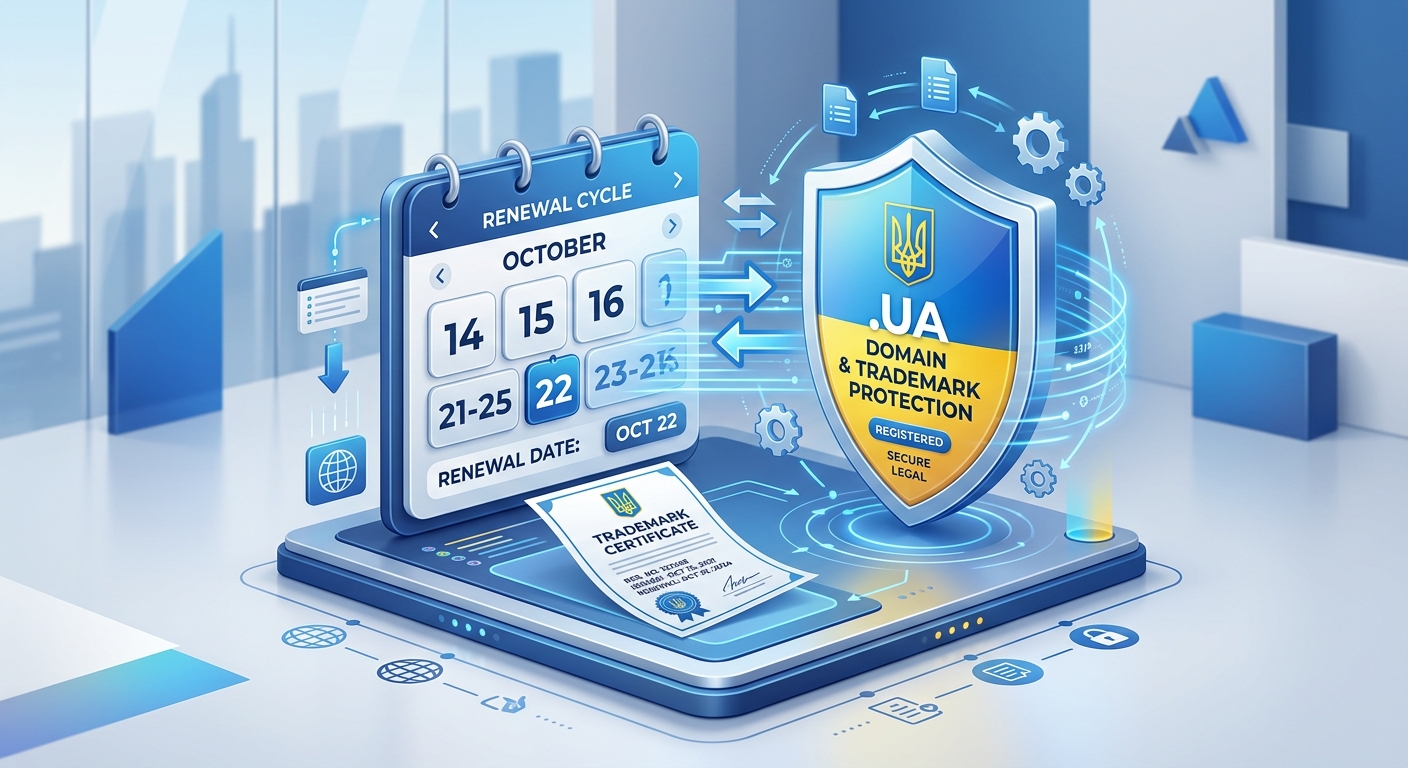
Owning a premium digital asset requires the synchronization of two different legal cycles: the life path of the trademark and the delegation period of the domain name. A TM certificate is issued for 10 years with the possibility of further renewal, while domain names in the .ua zone are usually registered for a period of 1 to 10 years, which creates a risk of a gap in legal protection due to simple forgetfulness.
The marketing and infrastructure value of your name grows every year, so it is important to consider the following nuances of maintaining rights:
- Date Synchronization: set a reminder for trademark renewal six months before the end of the ten-year term. If the TM expires, the legal basis for owning the .ua domain will disappear, which can be used by competitors.
- Payment Automation: for the domain, it is better to set up auto-renewal at the registrar. Unlike a TM, where the law provides a grace period for renewal, a domain can be put up for open sale almost immediately after the registration term ends.
- Business Scaling: a valid TM allows not only to hold the domain but also to safely enter marketplaces, launch franchises, or protect a YouTube channel name as a full-fledged brand.
To avoid unpleasant surprises, I recommend keeping the owner’s contact details (Email and phone number) in the registries up to date, as critical notifications about the need for payment are sent to them. When technical and legal renewal is set up, you can focus on strategic protection against external threats.
Traps and Risks: How Not to Lose Everything
Obtaining an address in the .ua zone does not guarantee eternal peace, as serious legal challenges lie ahead. We will look at the mechanisms of domain disputes and critical errors in brand spelling that threaten your intellectual property.
Domain Disputes and Cybersquatting
Even a flawlessly executed certificate does not make your site untouchable. In Ukraine, there is a UA-DRP procedure based on the rules of the WIPO Arbitration and Mediation Center. It allows intercepting the right to a domain through out-of-court arbitration if the opponent proves your bad faith.
To protect against accusations of cybersquatting, the domain owner must meet three criteria of “legitimate interest”:
- Use of the name before the dispute arose: existence of a real business, goods, or services under this brand.
- General awareness: confirmation that consumers associate the name specifically with your activity.
- Non-commercial or fair use: lack of intent to mislead users or resell the domain to a competitor.
It is important to understand that preventive trademark registration is not just a technical requirement for the .ua zone, but also the main legal argument in a dispute. If the TM is obtained only for “grabbing” an address without the intent to conduct business, arbitration may side with the opponent.
UA-DRP vs. Traditional Court: What to Choose?
| Parameter | WIPO Arbitration (UA-DRP) | Commercial Court of Ukraine |
|---|---|---|
| Speed | Very fast (up to 2–3 months) | Long (from 6 to 18 months) |
| Cost | Fixed admin fee (check current WIPO rate) | Court fee + costs for expertise and lawyers |
| Goal | Only transfer or cancellation of domain | Prohibition of use, damages, TM cancellation |
Expert Warning: If your trademark has not been used for more than 5 years (a term fixed in legislation), competitors can initiate its cancellation through the court. Without an active TM, you automatically lose the legal basis for owning the .ua domain. Keep evidence of brand use: copies of invoices, advertising layouts, and site screenshots in Archive.org.
Real case: One of our clients (a local online store) received a claim from an international corporation that owned a similar TM. Thanks to the fact that the client had a Ukrainian certificate and could confirm the sale of goods through the site for two years before the dispute began, WIPO arbitration recognized the existence of a legitimate interest and left the domain to the owner.
The material is for informational purposes. The UA-DRP procedure and court costs may change depending on current WIPO practice and Ukrainian legislation.
Errors in Name Transliteration
Technical errors when preparing documents can nullify even the most successful strategy of protection against cybersquatting and victory in a domain dispute. The administrator of the .ua zone, the company “Hostmaster”, requires absolute correspondence between the trademark characters and the domain name, where transliteration of Cyrillic names becomes the main stumbling block. If in your application the name “Щастя” turned into “shastya” instead of the normative “shchastya”, you simply will not be able to delegate the desired domain, even with a certificate in hand. Any inaccuracy in transliteration deprives you of the right to automatic address acquisition in the .ua zone, as the registrar has no right to interpret the name at its own discretion.
When developing identity and brand name, it is important to consider these linguistic nuances even before filing documents with NOIPI. Understanding these details allows you to avoid refusals at a stage when changing something in an already registered mark will be impossible. This is especially relevant when registering a YouTube channel name as a brand, where authors often use specific slang or letter combinations difficult to transliterate. Correctly selected transliteration ensures not only the technical possibility of obtaining a domain but also reliable brand protection from patent trolls who may try to register a similar domain with other spelling rules.
| Letter | Normative (Hostmaster) | Example in domain |
|---|---|---|
| Ж | zh | “Жорж” → zhorzh.ua |
| Й | i / y | “Йогурт” → yohurt.ua (at the beginning), “Гай” → hai.ua (at the end) |
| Щ | shch | “Щит” → shchyt.ua |
| Х | kh | “Харків” → kharkiv.ua |
| Є / Ю / Я | ye / yu / ya | “Яхта” → yakhta.ua (at the beginning of the word) |
These technical trifles form the overall success of the project, where every step — from choosing each letter to final legal fixation — must be part of a single well-thought-out system.
Your Path to .ua Starts with the Right Strategy
Finalizing the process of obtaining a .ua domain is a transition from owning just an “address on the network” to managing a full-fledged intangible asset. Since the zone administrator (Hostmaster) imposes strict requirements for full identity of the mark and domain name, any error at the document filing stage can lead to a refusal in delegation. That is why professional trademark registration is the foundation upon which a long-term strategy of brand presence on the Internet is built.
| Aspect | Action Now (with TM) | Delay (without TM) |
|---|---|---|
| Access to .ua | Guaranteed right to domain | Technical impossibility of registration |
| Cybersquatting | Protection via UA-DRP regulation | Risk of name capture by competitors |
| Scaling | Readiness for franchising | Legal vulnerability of business model |
As our clients’ experience shows, the question of how to protect a store name from copying most often arises after clone sites appear. However, Anton Polikarpov’s position is unambiguous: do not wait two years for the brand to become recognizable. Preventive securing of rights at the IP office (UkrNOIPI) level allows not only to obtain a domain but also to block attempts by patent trolls to use your reputation. This is critical both for local cafes and for digital projects, where registering a YouTube channel name as a brand becomes the only way to legally secure “digital territory” for yourself.
Understanding what trademark registration gives to small business — from monopoly on the name to anti-piracy tools — turns a legal procedure into a marketing advantage. Use the transliteration algorithm and Hostmaster requirements provided in this article so that your path to a top domain is fast and protected from legal traps.
Disclaimer: The material is for informational purposes and is not an individual consultation. Procedures are regulated by current Ukrainian legislation and domain registration rules, which may change. To check the status of objects, contact official UkrNOIPI registries.
If you need help with this task, use the trademark registration service.
Frequently Asked Questions
How does switching to a .ua domain affect SEO and site reputation?
Switching to a top-level .ua domain positively affects user and search engine trust, as it confirms business legality and the presence of an officially registered brand. From an SEO perspective, the .ua domain has a stronger regional link to Ukraine, which can improve site visibility in local Google search results.
To avoid losing accumulated traffic when switching from .com.ua to .ua, you must:
- Configure a page-by-page 301-redirect from all old addresses to new ones.
- Update data in Google Search Console.
- Inform customers about the address change via newsletters and social networks.
Usually, after a temporary fluctuation in positions (re-indexing period), sites on .ua domains show better growth dynamics due to a higher CTR (click-through rate) in search results.
Can I register a trademark to an individual to obtain a .ua domain?
Yes, Ukrainian legislation allows TM registration for both legal entities and individuals (including sole proprietors or just citizens). For obtaining a .ua domain, it does not matter if you are the owner of a large company or a private entrepreneur.
Registration to an individual is often even safer in terms of asset protection, as the TM remains in the person’s ownership even in case of business liquidation or reorganization. BrandR specialists recommend determining the ownership strategy in advance to avoid complex procedures of transferring rights in the future.
Can a .ua domain and TM be contributed to a company’s authorized capital?
Yes, a trademark certificate is an object of intellectual property rights that has a monetary valuation. It can be contributed to a company’s authorized capital as an intangible asset. A .ua domain name functioning on the basis of this certificate is usually valued in conjunction with the TM.
This gives the business several advantages:
- Increase in the company’s net asset value.
- Possibility to officially pay royalties to the TM owner.
- Improvement of the brand’s investment attractiveness for potential buyers or partners.
Does a Ukrainian trademark protect a domain name in international zones like .com or .org?
No, trademark (TM) registration in Ukraine is territorial in nature. This means it provides legal protection and exclusive rights to a domain in the .ua zone only within Ukraine. To protect a brand in international zones or national zones of other countries (e.g., .de for Germany or .pl for Poland), you must register the TM via an international procedure (Madrid System) or directly at the national patent office of the respective country.
It is important to understand that in general-purpose zones (.com, .net, .org), the “first come, first served” principle applies, and having a TM does not guarantee automatic rights to a domain, although it can be a weighty argument in courts or during dispute resolution under the UDRP procedure in case of cybersquatting.
Can a .ua domain be transferred or sold to another person separately from the trademark?
According to the .ua domain regulation, the right to its use is inextricably linked to the ownership of the corresponding trademark. Technically, you cannot simply “re-register” a domain to another person in the registrar’s cabinet if the new owner does not have rights to the same TM.
To legally transfer a .ua domain, you must:
- Conclude an agreement on the transfer of rights to the trademark and register these changes with the NOIPI (IP office).
- After the new person is listed as the TM owner in the registry, they will be able to submit an application to the registrar for domain re-delegation.
An alternative option is granting a license to use the TM, but most registrars require a full transfer of rights to the certificate to change the domain owner.
Who gets the .ua domain if there are two identical trademarks registered for different NCL classes?
In the field of intellectual property, a situation is possible where identical names are registered by different owners for goods and services that do not overlap (e.g., for furniture production and software development). However, in the domain name system, the “First come, first served” principle applies.
The TM owner who first submits an application for .ua domain registration to the zone administrator or an accredited registrar will receive this domain. The second owner of an identical TM will no longer be able to register the exact same address and will be forced to either look for another domain name or try to buy the domain from the first owner.