Why Your YouTube Channel Name Is Your Main Asset
Your channel name is the foundation of your capitalization, often worth more than hundreds of hours of recorded content. Let’s break down how to protect this digital asset and why a brand protection strategy begins with legal name registration.
Copyright vs. Trademark: What’s the Difference
Understanding the legal nature of your name helps avoid fatal mistakes in disputes with platforms or competitors. Below, we clarify where authorship ends and why trademark registration is necessary for full security.
Why Copyright Is Powerless Against a Name
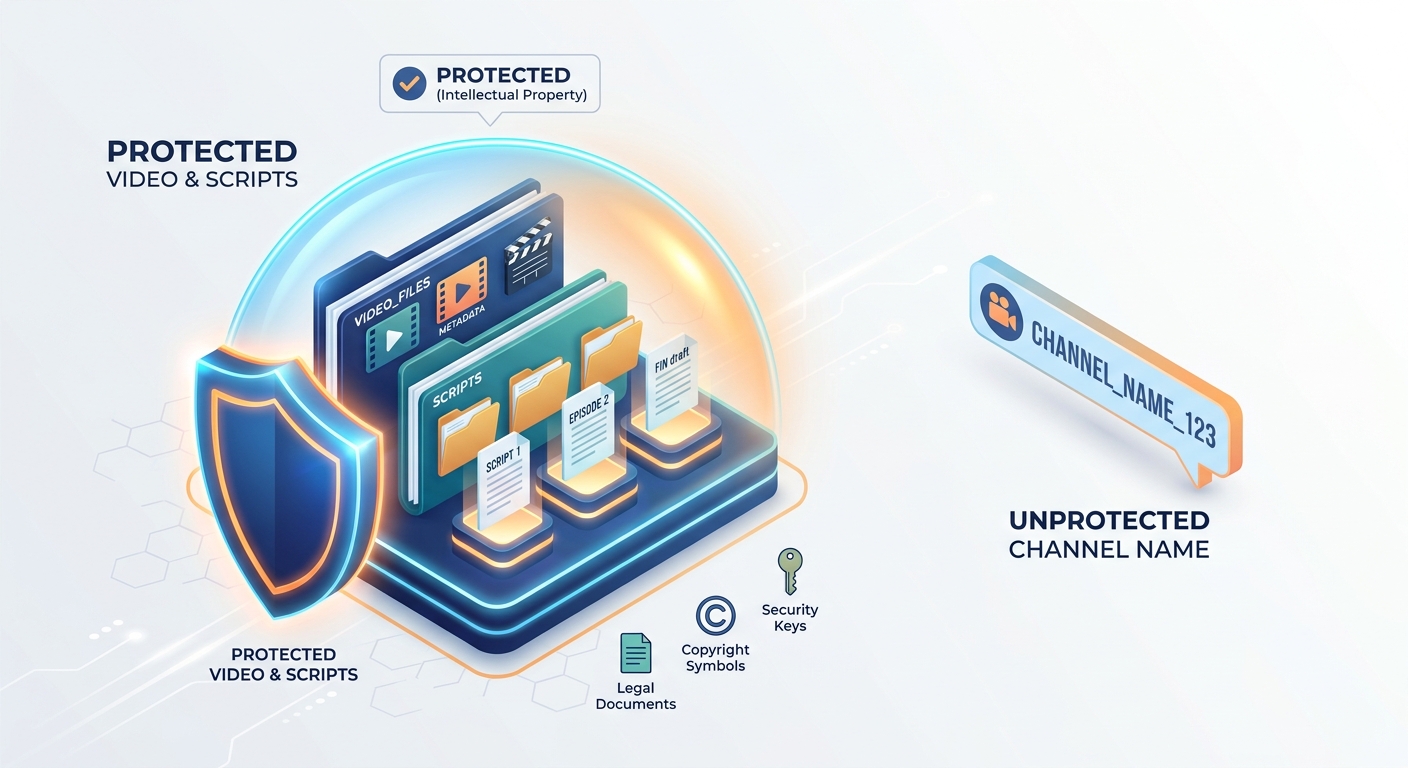
Most creators mistakenly believe that ownership of a name arises automatically the moment the first video is published. However, according to Article 10 of the Law of Ukraine “On Copyright and Related Rights”, ideas, methods of operation, concepts, or short phrases are not subject to protection. A channel name is usually a short word form lacking the creative originality required for “literary work” status. Without official status, you own only the content, not the name under which it is distributed.
The problem is identical to protecting a store name: copyright protects the form of expression (a specific video or script) but does not prevent others from using a similar name to attract an audience. To fully protect a name as a business asset, trademark registration is required.
| Criterion | Copyright | Trademark (TM) |
|---|---|---|
| What it protects? | Video, editing, music, script text | Name, logo, unique slogan |
| Basis of protection | Fact of creation | State certificate (IP Office) |
| Platform reaction | Removal of content copy (Copyright Strike) | Blocking copycat channels (Trademark Policy) |
Understanding what trademark registration offers small businesses and creators helps avoid legal traps. For example, one of our clients (owner of an educational media project) could not remove a copycat channel for a long time because YouTube moderation ignored references to the “channel creation date.” Only after presenting rights to the trademark were they able to prove a violation of the platform’s policy against misleading users.
Disclaimer: This material is for informational purposes only and does not constitute individual legal advice. Protection procedures may change in accordance with current IP Office practices and updates to YouTube’s internal rules.
This aspect is covered in more detail in a separate article: Do you need to register an Instagram shop name as a trademark?
Comparing Content Protection and Channel Name
Understanding the difference between copyright and a trademark is the boundary between amateur blogging and building a protected media business. Copyright protects the “body” of your content (video, sound, text), but it is powerless when a competitor simply names their channel after yours without copying the videos themselves.
In such cases, only registering a YouTube channel name as a brand helps. Unlike creative protection, a trademark (TM) focuses on identifying you as the original source in the market. It is a legal tool that allows you to appeal to platform administration in the event of copycat channels. We have summarized the key differences in a comparison table.
| Criterion | Copyright (CR) | Trademark (TM) |
|---|---|---|
| Object of protection | Specific work (video, script, editing) | Means of individualization (name, logo, slogan) |
| Main function | Protection of creative result | Differentiation from competitors and capitalization |
| Moment of origin | Automatically (from the fact of creation) | Exclusively after state registration |
| Validity period | Author’s life + 70 years | 10 years (renewable indefinitely) |
It is important to remember: copyright does not require formalities, but it does not grant a monopoly on words or names. Conversely, professional trademark registration provides the owner with the exclusive right to prohibit others from using similar names in a similar niche. As we noted in our brand protection strategy guide, each category of assets requires its own “legal armor” for safe scaling and protection against patent trolls.
Main Risks of Working Without TM Registration
The lack of legal armor makes a successful media project vulnerable to aggressive competitor actions. Below, we analyze the real threats of cybersquatting and the risks of receiving legal claims from third parties due to the use of an unprotected name.
Cybersquatting and Name Hijacking on YouTube
Cybersquatting in the digital environment has evolved: today, attackers hunt not only for domain names but also for recognizable media project names. When a blogger grows a channel to a million subscribers without taking care of official naming, they create ideal conditions for brand hijacking.
Imagine a typical scenario: your project becomes popular, you launch a line of merch or courses, and suddenly you receive a strike from YouTube. It turns out that a third party has already applied to the IP Office to register your name as a trademark for Class 41 or 35 of the Nice Classification. With priority or an existing certificate, the hijacker contacts Google support with a complaint about intellectual property rights infringement. To the platform’s algorithms, you are the infringer, and the person with the papers is the legal owner, even if they haven’t created a single minute of video. Similar mechanisms are common not only on video hosting sites, which is why business owners should know if registration is needed for social networks like Instagram, where blocking via TM happens even faster.
Advice from Anton Polikarpov: Do not wait for the “Gold Play Button” or the first million views to start the protection process. The cost of an early application is dozens of times lower than the cost of buying back your own name from a patent troll or legal proceedings to regain control of the channel.
In addition to direct name theft, ignoring registration procedures can lead to unintentional infringement of others’ rights, which entails even more serious consequences.
This aspect is covered in more detail in a separate article: Brand protection and business strategy: a complete guide for entrepreneurs.
Receiving Lawsuits from Brand Owners
Unintentional copying is a trap that creators with an original vision often fall into. The problem is that ownership of a name arises not from the moment the channel is created, but from the date of filing an application with the patent office. According to Art. 16 of the Law of Ukraine “On the Protection of Rights to Trademarks for Goods and Services”, the certificate holder can prohibit the use of not only identical names but also names confusingly similar.
Disclaimer: This material is for informational purposes only and does not constitute individual legal advice. Legal risks depend on specific Nice Classification classes and the priority date.
Practical example: One of our clients in the tech review sphere chose a name that coincided with the name of a software developer who had registered a TM for Class 42 (IT services). Despite the author working in Class 41 (entertainment), a conflict arose due to the intersection of interests in the digital environment, which almost led to the blocking of the entire media asset. A preliminary search through the Special Information System of the IP Office would have helped identify this risk before creating the visual design.
Checklist: Is your channel name in the “danger zone”?
- Phonetic similarity: The name sounds the same as an already well-known brand (even if spelled differently).
- Semantic identity: The translation of the name into a foreign language coincides with a registered TM in your niche.
- Presence of TM in related classes: Similar names exist in classes 35 (advertising), 38 (telecommunications), or 41 (educational and entertainment services) of the Nice Classification.
- Use of common words combined with unique ones: If you added “TV,” “Channel,” or “Blog” to a well-known brand, this does not exempt you from liability for infringement.
Judicial practice shows: an author’s claim that they “did not know” about the existence of another company is not an excuse. The court evaluates only the objective fact of the plaintiff’s certificate. Thus, registering a YouTube channel name as a brand is not just a legal formality, but the only way to legalize your presence in the media space and avoid demands for forced rebranding.
Bonuses of TM Registration for a Blogger
Trademark registration is not just about risk protection, but also about media business development. Learn how a certificate helps get verified, effectively fight fakes, and scale your channel into a profitable brand.
Channel Verification and Protection Against Fakes
Official brand status radically changes your relationship with the platform. For YouTube’s algorithms and support team, having a TM certificate is the strongest proof of your authenticity. It is not just a piece of paper, but a “golden ticket” that significantly simplifies getting the coveted verification checkmark. The platform strives to protect real rights holders, so registered trademark owners pass verification faster and with fewer bureaucratic hurdles.
Based on my experience communicating with Google support, I can state: complaints backed by a registration certificate number are prioritized. If someone creates a duplicate of your channel or uses your name to mislead the audience, you get powerful tools of influence:
- Fast removal of fakes: A special Trademark Complaint form allows you to block violators without long discussions with moderators.
- Control via Content ID: Having brand rights helps manage the identification of your content more effectively and prevent its illegal distribution.
- Legal advantage in disputes: In case of attempts to hijack the name by others, the document from the IP Office automatically makes your position stronger.
Protection against copying is the foundation upon which you build the trust of viewers and advertisers. When the audience sees official confirmation of the channel’s status, it increases the value of your advertising integrations and creates ideal conditions for further scaling into merch or franchises.
Scaling: Merch, Franchises, and Offline Business
When channel reach goes beyond the platform, the media name turns into a full-fledged commercial asset. At this moment, protecting your digital presence transforms into the foundation for building a business empire. Without proper legal status, any attempts to monetize the name outside of YouTube remain vulnerable, as brand ownership is confirmed not by the number of subscribers, but by a trademark certificate.
A trademark opens doors for the author that were previously closed due to legal uncertainty. It is a tool that allows you to legally scale the project in several directions:
- Releasing your own merch: you can not only print logos on t-shirts but also prohibit others from using your name for the production of clothing or accessories.
- Opening offline establishments: themed cafes, showrooms, or studios under the channel brand require name protection in the catering or service categories.
- Licensing agreements: you get the opportunity to officially sell the right to use your name to game developers, publishers, or manufacturers of goods, receiving royalties.
It is important to understand that for large retailers or franchisees, the lack of a registered brand for a blogger is a critical stop factor. No serious company will sign an agreement to use a name if you cannot prove your exclusive right to it. Registering a YouTube channel name as a brand is the only way to legalize the transfer of rights to third parties. Without this, you are effectively trying to sell air, which will lead to conflicts and financial losses in the future.
Once scaling goals are defined, it is necessary to move to the practical implementation of protection, which begins with a clearly defined procedure.
Brand Registration Process for a YouTube Channel
Moving from strategy to legal fixation of rights requires understanding a clear algorithm of actions. We will break down the path from checking an idea to receiving a certificate and the specifics of choosing categories of goods and services for content creators.
Stages of Turning a Name into an Official Brand
Official recognition of a YouTube channel name as an object of intellectual property is a marathon, not a sprint. The success of the procedure depends on the accuracy of actions at each stage, from the moment the idea arises to receiving the final document from the National Intellectual Property Authority. Each step in this process fixes your rights and creates a legal shield around the media project.
The main concept in this procedure is the priority date. This is the moment of filing the application, from which you effectively “book” the name for yourself. Even if the review takes a long time, anyone who files a similar name after you will be refused. That is why it is important not to delay formalizing your rights in the early stages of channel development.
The path to receiving a certificate usually consists of the following time and procedural stages:
- Week 1: Preliminary search. Our specialists check the name against databases of registered marks and filed applications to exclude the risk of refusal due to similarity with already existing brands.
- Month 1: Filing the application. Formation of the document package and official establishment of the priority date. This is a critical point after which you gain an advantage over competitors.
- Month 18–24: Examination and registration. The period during which the IP Office conducts a formal and qualification check. Provided there are no objections from third parties and no examination requests, you receive a certificate.
Keep in mind: currently, the procedure for accelerated trademark registration does not officially function in Ukraine. Any promises of a “guaranteed result in three months” are marketing manipulation or a sign of incompetence. Prepare for standard timelines provided by legislation.
In addition to timelines, correctly defining the scope of protection, which is realized through the selection of specific activity categories, is critically important.
Choosing the Right Nice Classification Classes for an Author
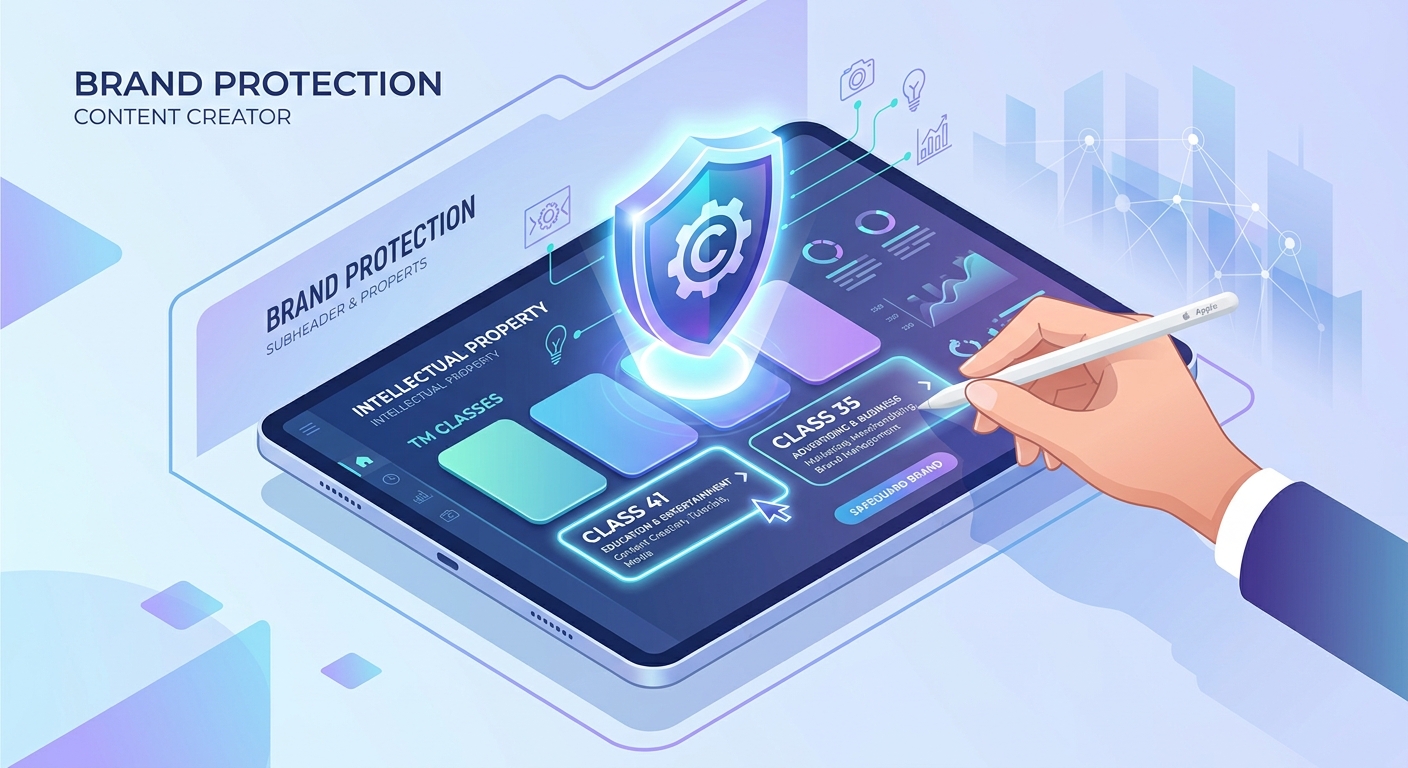
Defining the list of goods and services is not just a bureaucratic formality, but an outlining of the boundaries of your legal “territory.” In the intellectual property system, protection is not granted “for everything at once”; it is valid only within the limits of specific classes of the International Classification of Goods and Services (Nice Classification). If an author makes a mistake at this stage, their certificate becomes a beautiful but useless piece of paper that will not allow blocking a violator in a related niche.
For most content creators, three main directions are critically important:
- Class 41 (Entertainment and education): This is the base for any video blogger. It includes the creation of video content, show programs, educational courses, and direct entertainment activities. Without this class, you will not be able to prove that the name is used for its intended purpose.
- Class 35 (Advertising and management): Mandatory for those who do integrations, sell advertising time, or engage in influencer marketing. This class is also necessary if you plan to open your own online store under the channel name.
- Class 38 (Telecommunications): Provides protection in the field of streaming, broadcasts, and providing access to portals. It helps to secure the right to distribute a digital signal under a specific brand.
A common mistake is ignoring future scaling. For example, if a travel blogger registered the name only for “entertainment services,” they will not be able to easily prohibit a third-party firm from producing backpacks or suitcases under the same name. For real merch protection, you need to add classes for clothing (25) or accessories (18) in advance. A professional approach consists of fixing the name for all areas where the brand will potentially earn money; otherwise, you leave windows of opportunity for patent trolls and competitors. When the classification strategy is defined, the issue of responding to direct encroachments on your intellectual property comes to the fore.
How to Act When a Channel Name Is Copied
When third parties openly copy your name, it is time to move from observation to active legal counteraction. Below, we examine the algorithm for filing official complaints with the platform administration and tools for peaceful resolution of conflicts with violators.
Algorithm for Filing a Complaint with Google/YouTube
With an official certificate in hand, you gain the status of a legal rights holder, with whom the YouTube support team speaks quite differently than with the owner of “just an old channel.” The platform has clearly established mechanisms for trademark protection, but they work only if irrefutable legal evidence is provided. Your task is to turn an emotional claim into a structured legal case that will leave moderators no choice but to remove content or block the copycat channel.
Effective fight against plagiarism on the platform consists of the following steps:
- Fixation and evidence collection: Before writing a complaint, save links to all the violator’s videos and take screenshots of their channel’s main page. It is important to fix the very fact of using a name that is identical or confusingly similar to your registered mark.
- Filling out the Trademark Complaint form: Google provides a specialized tool for protecting rights to trademarks for goods and services. The form must include the certificate number and the country of registration. Without a state registration number, the complaint will most likely be rejected or reviewed for months as a “content dispute,” not an intellectual property infringement.
- Communication with the legal department: After submitting the form, you will receive a ticket number. If support asks for additional data, you need to clearly point to the Nice Classification classes in which your brand is registered and explain exactly how the violator’s activity misleads your audience.
Remember that YouTube usually does not take the side of authors in disputes over names if the complainant does not have registered rights. A certificate is your “passport” in the digital world, which automatically confirms priority. However, sometimes the situation can be resolved faster and cheaper, without waiting for the platform’s decision, through direct negotiations and official claims.
Peaceful Settlement and Claim Work
Filing an official complaint through the platform’s internal tools is only one path. Sometimes the Cease and Desist mechanism—a demand to stop the infringement of rights—is much more effective. This is not just a “letter of anger,” but a professional claim where a lawyer clearly spells out the legal position: your certificate number, the Nice Classification classes under which you are protected, and a list of the opponent’s illegal actions. Such an approach shows the violator that there is legal force behind you, not just the emotional dissatisfaction of a blogger, which often stimulates voluntary renaming of someone else’s channel without involving Google support.
Expert insight: in my experience, about 80% of disputes are resolved precisely at the pre-trial claim work stage. Most authors who “borrowed” someone else’s name simply do not want to get involved in expensive and lengthy conflicts when they see that you have a real legal asset in your hands and a readiness to go to the end.
Peaceful settlement is often a more rational choice for a media business than exhausting lawsuits. You can agree on the transfer of a domain or a change of nickname on social networks within a week, instead of waiting months for a court decision. Furthermore, competent claim work allows you to preserve your reputation, as public wars over a name often harm both sides. It is important to understand that the success of such negotiations directly depends on how well the registration of your name on YouTube as a brand was conducted and whether all risks of similarity with other market players were taken into account at the identity creation stage.
Now that you understand the mechanics of fighting for your own name, it is worth looking at the big picture and realizing the value of your asset.
Your Media Brand Deserves Professional Protection
Your YouTube channel is a full-fledged asset, and ignoring the legal foundation for it is as risky as building a capital building on a rented plot without an official contract. Platforms change the rules of the game, but ownership, fixed in accordance with the Law of Ukraine “On the Protection of Rights to Trademarks for Goods and Services”, remains an unshakable protection of your name in the media space.
Practice shows that without paper confirmation of rights, even a million-subscriber channel can become a victim of simple blackmail. For example, one of our clients faced an attempt to hijack their unique “Handle” (@name): a competitor filed an application for an identical TM in educational services classes to subsequently block the original channel via Google’s Trademark policy. Only timely counter-registration of the trademark and professional opposition allowed the media brand to be saved.
Checklist: when your channel critically needs legal protection:
- You receive stable income from direct advertising or partner networks.
- The channel name has become recognizable and is used as a nickname on other social networks.
- You are planning to launch merch, private clubs, or training under this brand.
- Copycat channels have appeared that parasitize on your traffic.
To form a global understanding of how legal security affects the capitalization of your project, we recommend studying our material: Brand protection and business strategy: a complete guide for entrepreneurs. This will help you integrate intellectual property into your overall business model.
The Brandr team takes on all stages—from preliminary search in registries to monitoring subsequent violations. We provide you with the opportunity to create content calmly, knowing that the channel name is securely booked for you. Protect your media capital today so you don’t lose it tomorrow.
Disclaimer: This material is for informational purposes only and does not constitute personal legal advice. Registration procedures and legal approaches may change depending on current IP Office practices and updates in legislation.
If you need help with this task, use the trademark registration service.
Frequently Asked Questions
Does a Ukrainian trademark protect a channel name if my audience is in the USA or Europe?
A trademark has a territorial character. This means that registration in Ukraine provides legal protection only on the territory of our state. If your content is oriented toward the international market, you should consider one of two paths:
- Madrid System: allows you to file one international application and extend protection to dozens of countries simultaneously.
- Direct registration: filing an application directly with the patent office of a specific country (e.g., USPTO in the USA).
For global brands, having a Ukrainian certificate becomes the basis for international registration under a simplified procedure.
Does registering a channel name as a TM help get a domain name in the .UA zone?
Yes, this is one of the key technical advantages. In Ukraine, registration of a top-level domain .ua (e.g., channelname.ua) is possible exclusively if there is a registered trademark that completely coincides with the domain name. This allows the content author to create a professional site, protected from cybersquatters, and increase the trust of advertisers.
Can an individual register a brand for themselves, or is it necessary to open a sole proprietorship (FOP)?
Ukrainian legislation allows registering a trademark both to a legal entity or FOP, and to an ordinary individual. For many beginner authors, registration as an individual is more convenient because:
- Ownership of the brand remains with you even in the event of closing business activities.
- You can later transfer rights to the TM to your own company or grant a license for use.
However, if you are planning large-scale commercialization and royalty payments, it is worth consulting with lawyers in advance regarding the tax consequences of each of the options.
What is better to register: only text (name) or the channel logo together with the text?
The most reliable option is considered to be the registration of a word trademark (the name itself). This gives you the right to protect the word regardless of its graphic execution, font, or color. If you register the name only as part of a logo (combined TM), then with a significant change in the logo design, the protection may weaken. The optimal strategy for large channels is registering the name as a word mark and separately the graphic logo as a separate object.
How to find out that someone else is trying to register a name similar to mine while I am still in the process of registration?
Since the registration process lasts from 18 to 24 months, it is critically important to carry out monitoring of new trademarks. Professional services, such as BrandR, allow you to track the filing of applications by competitors at the publication stage. If you notice a similar name, you will be able to file a reasoned objection against its registration, citing your priority, and block the issuance of a certificate to the opponent.
Does having a trademark affect the value of the channel when selling it or attracting investors?
Undoubtedly. A YouTube channel without registered intellectual property is perceived by investors as a risky asset. Having a TM certificate turns a media project into a full-fledged intangible asset, which:
- Is reflected in accounting (for companies).
- Can be officially transferred under an assignment agreement.
- Increases the market value of the business by minimizing the risks of lawsuits and platform blocks.