Why a preliminary check saves your budget
Most entrepreneurs view state registration as a mere formality; however, ignoring the preliminary check stage turns this process into a lottery where the stakes are your budget and the right to use your own brand name. This article explains why professional risk analysis serves as a reliable insurance policy for your business, allowing you to avoid conflicts with already registered trademarks and save months of waiting.
Why filing “blind” is a waste of money
Filing an application without understanding the actual state of the registry often leads to the irreversible loss of government fees due to similarities with third-party rights discovered later. Below, we will analyze in detail the financial consequences of such errors and the critical delays that arise during the registration process.
Risk of Refusal and Loss of Fees
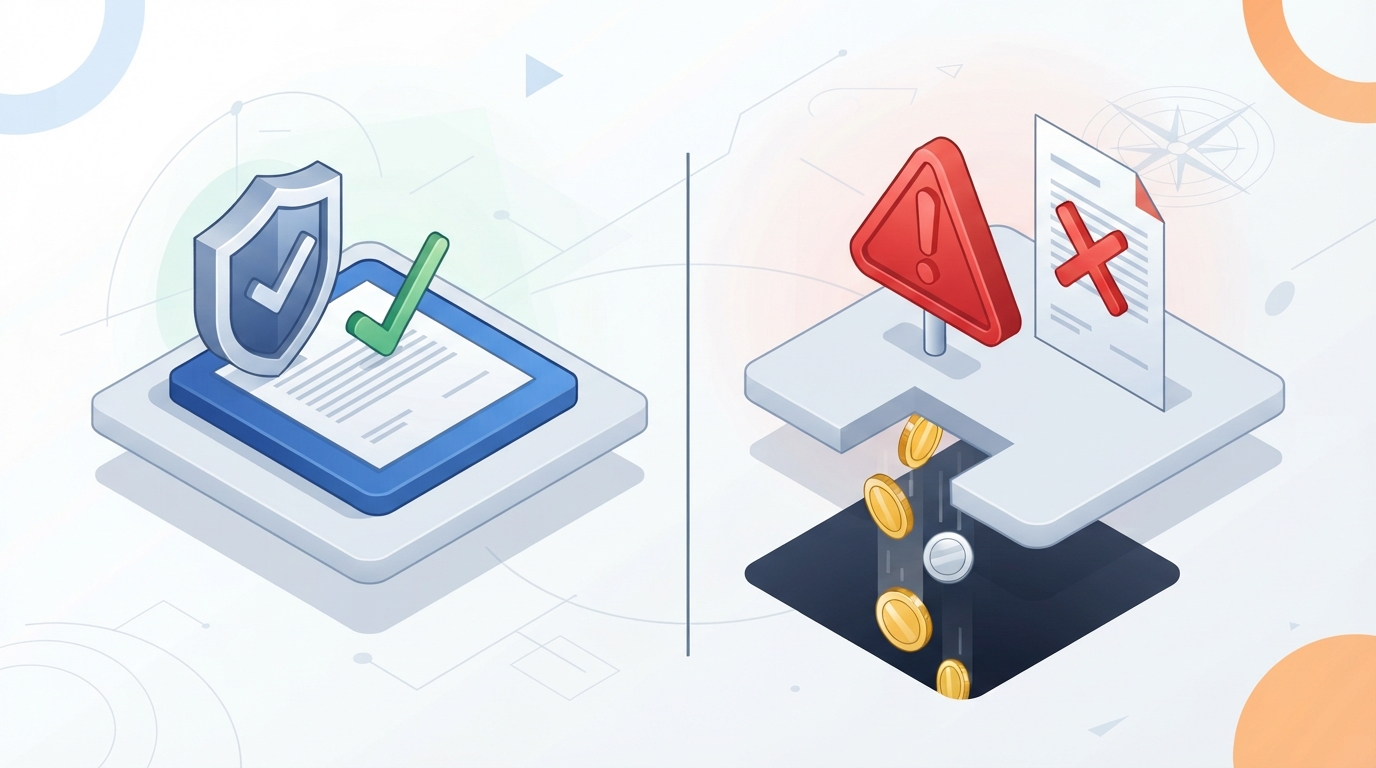
Many businesses make the mistake of assuming that the acceptance of an application by the IP Office and the payment of fees guarantee registration. Remember: government fees cover only the expert review of the application, not a positive outcome. About 80% of refusals can be prevented before filing through a professional search that considers phonetic, visual, and semantic similarities between marks.
| Criterion | With professional search | Without preliminary search |
|---|---|---|
| Predictability of result | High: conflicts identified in advance | Low: risk of unexpected refusal |
| Economic feasibility | One-time costs | Risk of additional costs for appeals or rebranding |
Our client filed an application on their own without considering a conflict in specific NICE classification classes. The situation was saved only by preparing a complex legal position justifying the lack of confusion. However, this process cost the client significantly more resources than a professional trademark registration would have the first time. We recommend reviewing the official guidelines on trademark similarity to understand the complexity of the internal examination logic.
Related material on the topic: Refusal of TM registration.
Time Lost to Waiting
In intellectual property, time is a critical resource that businesses lose due to strategic mistakes at the start. When an application is filed without a professional audit, you put your brand development on “pause,” the duration of which depends on the examination cycles of the IP office. Receiving a refusal after many months of waiting means not only the loss of paid fees but also the need for a complete change in marketing strategy.
The procedure provided by the Methodological Recommendations on Trademark Similarity does not allow for correcting fundamental errors in a name once the examination has begun. A discovered conflict with an already registered brand turns investments in marketing, domains, and signage into a legal risk. Correcting such errors often requires a complex appeal procedure, which delays market entry by 18–24 months.
Case Study: The Price of Unaccounted Risk
Our client independently filed an application to register a name for an IT service. A year later, a preliminary refusal was received due to similarity with a well-known mark in an adjacent segment. We successfully challenged this decision by justifying the lack of confusion in consumer perception, but it required significant effort. If the trademark registration had been accompanied by a professional search at the planning stage, we could have adjusted the strategy in a few days without risk to the project.
Many errors arise from a misunderstanding of how to properly select Nice Classification classes, as conflicts most often occur within adjacent fields of activity. Delegating the verification to specialists minimizes the probability of a “strategic dead end,” allowing for the early detection of phonetic, visual, or semantic similarities that standard search engines often ignore.
Search Mechanics: What Exactly Are We Looking For
Professional analysis of a designation is based on a comprehensive study of its structure and comparison with existing registrations, taking into account specific criteria for similarity to the point of confusion and the correct selection of classes of goods and services.
Criteria for Trademark Similarity

The IP office’s examination process operates according to clearly defined algorithms, where the main enemy of your brand is not an identical copy, but “confusing similarity.” This is a situation where a consumer might mistake your product for that of another manufacturer. To determine such a risk, lawyers and experts use three main filters through which every new designation is passed.
Expert insight: Similarity is not mathematical equality. Even if names are spelled differently but sound almost the same (phonetic similarity) or evoke identical associations (semantic similarity), the risk of refusal approaches a critical level. An expert always evaluates the overall impression that a sign makes on an average buyer.
To minimize risks, during the verification process, we analyze the sign according to the following parameters:
- Phonetic similarity: evaluation of stresses, number of syllables, and consonance of letters (e.g., “Zon” and “Sonn”).
- Visual similarity: analysis of fonts, graphic elements, color schemes, and the overall composition of the logo.
- Semantic similarity: checking the meanings of words, translations into other languages, and semantic associations (e.g., an image of a wolf and the word “Wolf”).
Even a unique word can become a problem if it overlaps with another brand in the same field of activity, so the next critical step is a detailed analysis of the relevant business categories.
Analysis of Nice Classification Classes
Understanding similarity criteria is only half the battle, as the legal weight of any overlap directly depends on the specific niches in which you operate. Proper trademark searching and the selection of Nice Classification classes determine whether your brand will become the subject of lawsuits in the future.
Many applicants make the mistake of choosing Nice classes haphazardly or too narrowly. According to the IP Office Guidelines on Trademark Similarity, experts evaluate not only identity but also the relatedness of goods and services. For example, class 32 (non-alcoholic beverages) and class 33 (alcoholic beverages) are often considered related; therefore, identical names in these categories are guaranteed to lead to a refusal due to “similarity to the point of confusion.”
Professional analysis requires a comprehensive approach: you must consider phonetic similarity (how the name sounds), visual similarity (graphic design), and semantic similarity (meaning). Add to this the verification of transliteration, variations in Latin and Cyrillic spelling, and an analysis of applications already undergoing examination. Self-selection based on keywords without considering these parameters often ends in refusal, and there is no official provision for correcting errors once the procedure has begun.
Thorough document preparation and strategic determination of the list of classes are the best ways to avoid delays that could stretch the market entry process by 18–24 months. You can learn more about the nuances of the Nice Classification in our detailed article, but remember: a high-quality audit is a roadmap that allows you to identify and neutralize risks before filing an application.
Scenario: Before and After the Audit
To clearly demonstrate the power of a legal audit, we will analyze a real-life situation from our practice, where the timely identification of critical obstacles allowed a client to protect their investment and successfully enter the market. In the following sections, we will examine a brand modification case and hear warnings that will help you avoid pitfalls when preparing documents on your own.
Case Study: How We Changed a Name

In our practice, we encountered a case where a food production company approached us after having already developed a full identity and printed a test batch of packaging. During our audit, we discovered a registered trademark that differed by only one letter and belonged to a major market player in a related class. Filing the documents as they were would have guaranteed a conflict and a court-ordered ban on using the brand.
Case Study: Adjusting a Brand Before Filing
Situation: The client planned to register a name phonetically similar to an existing popular confectionery brand. Direct registration was impossible due to the high risk of consumer confusion.
Solution: Instead of taking the risk, we proposed changing the semantic focus. We added an original graphic element and a specific verbal clarification to the name, which altered the overall perception of the mark. We also narrowed the list of goods, excluding positions where the overlap with the opponent was critical.
Result: The application passed examination without a single inquiry from the IP Office (UANIPIO). The client received the certificate without spending a single day on litigation or preparing responses to preliminary refusals.
This example proves that a preliminary search is not just about finding prohibitions, but a tool for maneuvering. When we see a “red zone,” we have time to change the font, add a unique graphic symbol, or adjust the phonetics. This is much cheaper than trying to defend the right to a name after you have already received a preliminary refusal and your marketing budget has already been spent. Most fatal mistakes occur due to the belief that “my logo is definitely different,” even though the examination views the brand through the eyes of an average buyer who does not scrutinize the details.
That is why an experienced lawyer looks not for identity, but for potential grounds for claims, which allows for preparing a brand for safe navigation in a competitive environment.
Important Expert Warnings
In my practice, I often encounter cases where clients perceive a trademark search as a mere formality, similar to checking for an available domain name for a website. However, the reality is much stricter: a lawyer analyzes not just the presence of the same word in a database, but the likelihood of a legal conflict, taking into account even remote associations that may arise in the consumer’s mind. Conducting a trademark search independently through public registries often provides a false sense of security, as beginners do not see applications currently under review and lack the expertise to assess “confusing similarity.”
Anton Polikarpov’s Warning: A search is not just a database query; it is a legal opinion on the probability of a conflict. Even if a name differs by only one letter but sounds phonetically identical, the IP office will likely issue a preliminary refusal with an 80% probability. An expert examination looks at a brand systematically: how it sounds, how it looks, and what meaning it conveys.
When entrepreneurs try to assess the prospects of registration, they often ignore the complexity of semantic analysis. For example, the name “Apple” is unique for computers, but for selling apples, it is descriptive and will not receive protection. To help you understand the types of similarity we deal with most often, I have prepared a brief classification of risks:
| Type of similarity | What the risk entails | Example of conflict |
|---|---|---|
| Phonetic | Words sound almost identical despite different spellings. | “Q-tek” vs. “Kutek” |
| Visual | Similarity in graphic elements, fonts, or overall composition. | Using an identical symbol in a different color |
| Semantic | Names have the same meaning (translation). | “Sontse” and “Sun” in the same product category |
If the search results are disappointing, it is not a reason to shut down the project, but a signal to make a professional maneuver, which we will discuss next.
Related material on the topic: Step-by-step guide to registering a trademark for goods and services in Ukraine in 2026.
What to do if matches are found?
When a professional search reveals critical matches with existing brands, it is important not to panic, but rather to choose a modification strategy or obtain legal consent from the owner of the similar mark for further operations.
Brand modification to avoid refusal
About 80% of registration refusals can be avoided through a high-quality preliminary search, which identifies conflict risks before filing an application with the IP Office. Professional analysis allows for the identification of potential obstacles that cannot be detected during a standard search.
Using professional trademark registration allows you to adapt your brand using the following methods:
| Method | How it works |
|---|---|
| Graphic uniqueness | Changing the font style or adding dominant visual elements. |
| Semantic shift | Adding descriptors that clarify the brand’s scope of activity. |
| Focus on Nice Classification | Narrowing the list of goods to differentiate from a competitor. |
Practical example: Our client faced a name similarity issue with a well-known market player (approximately 70% similarity). Instead of abandoning the brand, we changed the graphic execution of the logo and excluded items that created direct competition from the product specification. This allowed us to obtain the certificate without lengthy appeals.
Important: these methods do not guarantee 100% success, as the final decision is based on the subjective assessment of the office’s examiner. The path to registration can be complex and may require lengthy appeal procedures; no preliminary analysis eliminates the risk of receiving a preliminary refusal, which will require professional legal defense.
Working with a Letter of Consent
When a potential conflict is identified during the analysis, it does not always mean the end of the road for your brand. One of the most effective tools in both international and Ukrainian practice is obtaining a Letter of Consent — an official document in which the owner of a previously registered mark confirms that they do not object to the registration of your name. This turns a legal confrontation into civilized negotiations, where both parties can coexist in the market under certain conditions.
Many entrepreneurs believe that the trademark registration procedure is just a matter of filling out forms in an electronic portal. However, it is at the stage of dealing with conflicts that “hidden pitfalls” arise for beginners. Without professional guidance, it is difficult to correctly select Nice Classification classes in a way that narrows the list of goods and makes the Letter of Consent a compelling argument for the IP Office expert. Legal literacy in preparing this document is critical: it must be irrevocable, clear, and compliant with the requirements of current legislation.
| Agreement Element | Description and Benefits |
|---|---|
| Territorial limitation | The parties agree not to enter each other’s specific markets. |
| Product differentiation | Detailing the list of goods within the same Nice Classification class to eliminate confusion. |
| Visual differences | Commitment to use only specific colors or graphic elements. |
Such an approach requires a deep understanding of how experts assess risks to the consumer. If a conflict of interest seems inevitable, professional preparation of the argumentation becomes the only chance to save your investment in the name.
If you need help with this task, take advantage of our offer for trademark registration.
Preliminary search is your protection
A professional trademark search is not just a formality, but a strategic audit that saves up to 80% of applications from a guaranteed refusal by the IP Office. Attempting to register a brand blindly turns into a dangerous lottery, where your government fees and years of waiting are at stake. To build a reliable legal foundation for your business, study our step-by-step guide to registering a trademark for goods and services or contact the specialists at Brandr.legal for a detailed risk assessment.
Frequently Asked Questions
Can I check a trademark myself using open databases?
Technically, you can use free tools such as the Trademark Database of the IP Office (UANIPI) or WIPO search engines (for international marks). However, it is important to understand the limitations of this approach:
- Lack of professional interpretation: Databases only provide identical or partially similar results. They do not take into account subjective criteria used by experts, such as “likelihood of confusion,” which professionals evaluate comprehensively.
- Complexity of semantic search: A simple database may not suggest that your name has the same semantic meaning as another mark but in a different language (for example, the English Moon and the Ukrainian Місяць).
- Risk of omission: Automated systems do not see the context within Nice Classification classes, where similar but not identical goods may trigger objections from the examination.
A self-check is a basic filter, but it does not replace a legal opinion, which is necessary to minimize the risks of refusal.
Why does the choice of Nice Classification classes directly affect registration success?
The Nice Classification of Goods and Services defines the “battlefield” for your trademark. Errors in selecting classes lead to two main problems:
- Excessive breadth: If you specify too many goods, you automatically increase the number of potential “competitors” in the databases, which raises the likelihood of a conflict.
- Insufficient protection: If you do not include important classes, your brand will remain vulnerable to competitors in related fields.
The right strategy lies in balancing commercial plans with legal security. We recommend reviewing the details of selecting Nice Classification classes to understand how to protect the specific market segment where you plan to operate.
What is a Letter of Consent and when is it appropriate to use?
A Letter of Consent is an official document in which the owner of a previously registered trademark grants permission for the registration of a similar mark by another person. It is an effective tool for amicable settlement, used under the following conditions:
- Companies operate in different geographical regions.
- Goods or services have different target audiences, even if they belong to the same Nice Classification class.
- The owners have reached a commercial agreement that precludes the possibility of misleading consumers.
However, it should be remembered that an IP office examiner is not obligated to accept a letter of consent as an indisputable basis. If, in the opinion of the examiner, the names still create a critical risk of confusion for the consumer, registration may be refused despite the existence of the letter.
What is the difference between identity and confusing similarity?
Understanding this difference is critical for your brand protection strategy:
- Identity: This is an exact match, “character for character.” It is a situation where your brand is identical to one that is already registered. This almost always leads to a refusal.
- Confusing similarity: This is a more subtle category. It occurs when an average consumer, upon seeing your brand, might assume that it is a product from the same manufacturer or that the companies are related. This is evaluated through three filters:
- Phonetics: whether the names sound similar.
- Visualization: whether the spelling, fonts, or logos are similar.
- Semantics: whether the names carry the same meaning.
It is precisely “confusing similarity” that is the cause of 80% of refusals, because entrepreneurs often believe that if a name is written in a different font or has a changed letter, it becomes “unique” — however, the law views this more broadly.
How quickly can you change a brand if a conflict arises after filing?
Unfortunately, once an application has been filed, the possibilities for making changes to the name itself or the graphic element of the mark are extremely limited. According to the rules, you can only narrow the list of goods and services (remove specific items that caused the conflict).
If you discover a problem after filing:
- Don’t panic: You need to analyze the notification from the examiner (preliminary refusal).
- Weigh the costs: Sometimes it is cheaper to file a new application for a modified brand than to spend years appealing in the Board of Appeals.
- Modification strategy: If you haven’t filed yet, you have room to maneuver: changing descriptors, adding graphic elements, or shifting the semantic focus (as we do at BrandR when risks are detected).
We recommend reading our article on preparing a response to a refusal if you have already received comments from the IP office.