Patent or Copyright: What Should an Owner Choose?
The choice between patenting and copyright is a strategic decision where a mistake at the start can cost a business its market monopoly. In this article, we will break down real figures and timeframes so that you have a clear understanding of the difference between a patent for an invention and copyright for protecting your assets.
Fundamental Difference in Protected Objects
To build an effective protection strategy, it is necessary to distinguish between the technical essence of a solution and its external form. Below, we will analyze in detail the specifics of protecting inventions and the features that copyright registration offers as a tool for protecting creative works.
What a Patent for an Invention Protects

When we talk about a patent for an invention, we are not just protecting text or drawings, but the engineering concept itself — a specific way of solving a technical problem. This is the strongest level of protection in intellectual property because it allows you to prohibit competitors from using the core of your technology, even if they implement it in a different design. To obtain such protection, the object must meet strict criteria: it must have an inventive step, be new on a global scale, and be capable of industrial application.
“I always emphasize to clients: in a patent, the technical description is key. If you make a mistake in describing the patent claims, you are essentially gifting your idea to the world, because competitors will be able to easily bypass your protection by changing only one minor detail,” says Anton Polikarpov.
Preparing patent documentation requires the involvement of not only lawyers but also technical specialists, as legal protection extends to the set of essential features set forth in the claims. Unlike literary or artistic works, where only what we see or hear is protected, a patent “seals” the logic behind how a device, substance, or process works. Understanding this distinction is critical when you are debating whether to choose patent protection or rely on copyright tools for your innovative product.
Now that we have clarified the technical complexity of patenting, it is worth considering a more flexible tool that focuses on the form of expression of an idea.
Copyright: Form of Expression
Unlike patenting, where the technical “core” and process logic are subject to protection, copyright focuses exclusively on the form in which your idea is embodied. It does not prevent others from using the idea or method, but it makes the copying of specific text, code, or visual execution illegal. Understanding this difference allows a business to allocate resources properly: instead of trying to patent something that can be protected much faster and cheaper as an object of creativity.
According to the Law of Ukraine “On Copyright and Related Rights”, protection arises automatically from the moment a work is created. However, for businesses, especially in IT or creative industries, it is critically important to have an official certificate. It serves as ironclad proof of authorship, which is recognized by courts and marketplaces. The following are protected:
- Computer programs and databases: the source code is protected as a literary work.
- Textual content: articles, technical documentation, product descriptions.
- Visual objects: photographs, graphic interface designs, illustrations.
- Architectural and design solutions: if they have a creative character.
Remember: the law protects the creative contribution, not the functionality. If a competitor writes their own program that performs the same function but has different code, it is not a violation of rights. If you wish to secure an official status for your developments, registering a copyright object is the optimal way to protect your interests.
Comparison of Registration and Maintenance Costs
The choice between a technical patent and the registration of a creative object depends not only on the nature of the development but also on the business’s willingness to invest in its maintenance. Below, we analyze the financial structure of both procedures.
Financial Structure of Patenting
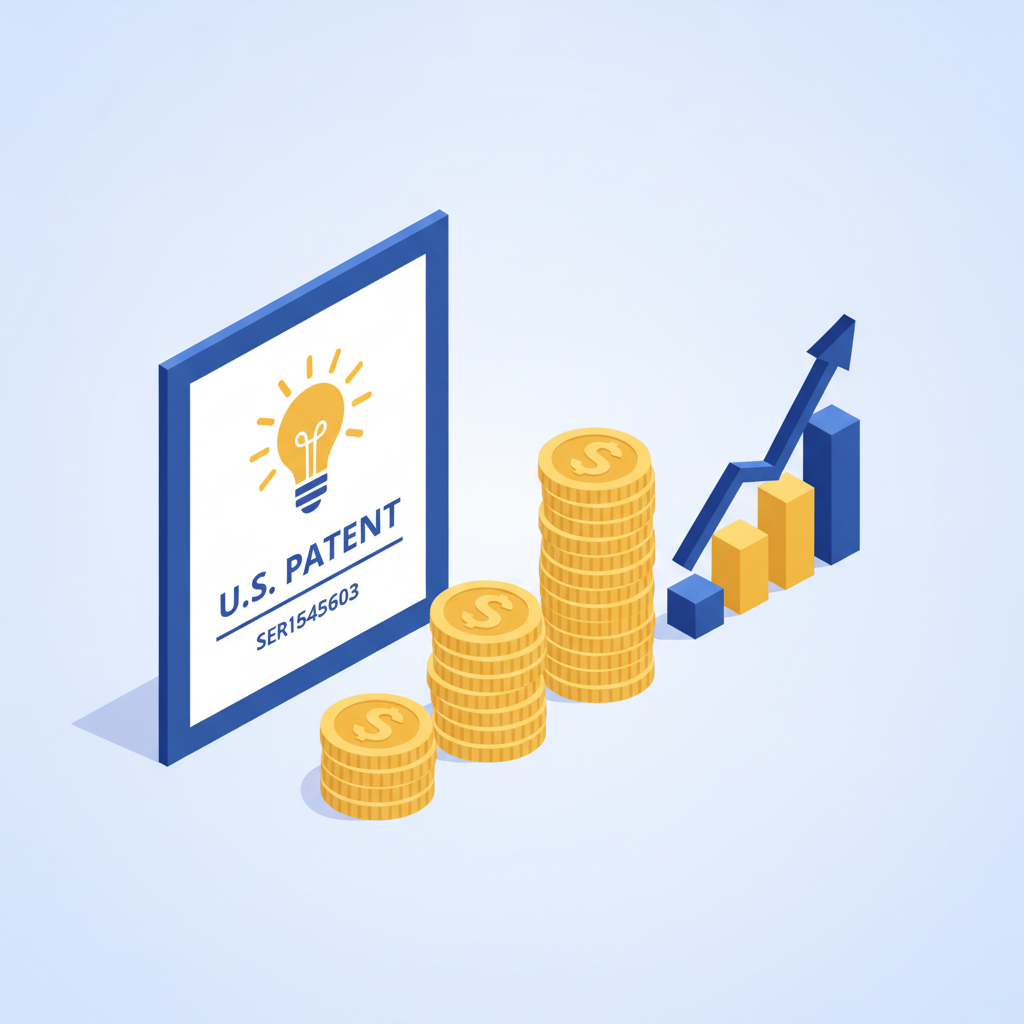
A patent is a strategic tool for financial monopoly that involves a multi-level cost structure. Unlike copyright, where fee payment is a one-time act upon registration, the patent system requires periodic investments throughout the entire term of validity. According to official data from the IP Office (UkrNOIVI), the total cost consists of the application filing stage, the examination stage (the most expensive part), and mandatory annual payments to maintain validity.
| Stage / Type of Payment | Funding Features |
|---|---|
| Filing an application | Includes a filing fee, which depends on the volume of the invention claims. |
| Substantive examination | Payment for verifying novelty and inventive step. |
| Maintenance of validity | Annual contributions, the amount of which increases proportionally with the patent’s term. |
A common mistake is the expectation that a one-time payment guarantees indefinite protection. Failure to pay the annual fee results in the expiration of the patent, which effectively nullifies previous investments. If an intellectual property object does not have the characteristics of a technical invention, it is more advisable to choose copyright registration, which is free from the complex system of annual contributions and lengthy examinations.
Availability of Copyright Registration
Unlike patenting, where the financial burden on the intellectual property owner increases due to mandatory annual maintenance fees, copyright registration is based on a one-time investment model. The owner pays a state fee only for the preparation and issuance of the certificate, after which the asset requires no additional expenses throughout its entire term of validity — the author’s life plus 70 years.
According to the explanations provided by the Ukrainian National Office of Intellectual Property and Innovations (IP Office), this approach significantly simplifies intangible asset management for businesses. Understanding the difference in financial planning, startups choose this instrument as a reliable way to secure rights to code or graphical interfaces from day one, avoiding the risks of missed payments inherent in patents.
- Preparation of the application and a copy of the work (e.g., source code or visual materials).
- Payment of statutory state registration fees.
- Submission of the document package to the IP Office for formal examination.
- Issuance of the certificate, which confirms authorship without the need for renewal.
To ensure accuracy and minimize errors in submitted documents, you can utilize professional assistance from BrandR by choosing our “turnkey” registration service. This approach allows businesses to focus on product development, with the confidence that the legal framework for intellectual property protection is properly established.
Note: All information provided is for informational purposes only. Official fee rates and procedural requirements are regulated by Ukrainian legislation and may be changed by authorized bodies.
Related material on the topic: Patent for an Invention or Copyright.
Timeframes: From Filing to Result
The speed of obtaining a protection document directly affects the product’s market entry strategy. Below, we compare the duration of patent examination for an invention and the timeframes for obtaining a copyright certificate.
Duration of Patent Examination

The patenting procedure differs significantly from copyright registration. Since a patent secures a monopoly on a technical solution, experts from the UANIPIO (IP Office) conduct a thorough qualification examination: they analyze the novelty, inventive step, and industrial applicability of the claimed object.
Estimated patent examination cycle:
- Stage 1 (2 months): Filing the application and establishing the priority date.
- Stage 2 (4 months): Formal verification of compliance with legislative requirements.
- Stage 3 (12–24 months): Qualification examination for patentability criteria.
- Stage 4 (3 months): State registration, publication of information, and issuance of the patent.
It is important to consider that failure to respond to examiner inquiries on time or failure to pay fees in a timely manner may lead to the withdrawal of the application without the possibility of restoring priority. Due to the length of this process, for businesses seeking to promptly secure rights to visual elements or software code, copyright registration may be more appropriate, as it does not require such a complex and lengthy examination.
Common Risk: Underestimating the duration of the patent cycle. For products with a short life cycle (e.g., seasonal solutions), a multi-year wait for a patent is often unprofitable. In such cases, it is recommended to consult with a specialist beforehand to assess the feasibility of choosing between patenting and copyright protection.
Speed of copyright registration
Unlike a lengthy patent examination, which requires considerable patience from a business, the procedure for obtaining a certificate for a work feels like a true sprint. In the Ukrainian context, this is the most efficient way to record your rights in the state register. The bulk of the time here is spent only on a formal check of the document completion and the payment of fees.
For startups and small businesses, this pace is critical, as it allows them to obtain an official document in a short timeframe, which is important for signing license agreements or applying for grants. Although an expedited registration procedure does not officially exist in Ukraine, a well-prepared package of documents minimizes the risk of inquiries from experts that could delay the process. By understanding the difference between tools such as a patent for an invention and copyright, an owner can quickly protect the visual part of a product or software code while a more complex patent application is being prepared.
- Application in the prescribed form (in Ukrainian);
- A copy of the work in tangible form (a file with code, printed text, images);
- Document confirming payment of the state fee for preparation for registration;
- Document confirming payment of the fee for the issuance of the certificate;
- Documentary confirmation of the date of completion of the work on the creation;
- Power of attorney for a representative (if the application is submitted by a lawyer).
Correctly classifying intellectual property based on its form of expression allows you to avoid wasting resources on complex technical descriptions where it is sufficient to record authorship of content. This approach ensures a fast market entry with already protected assets, which prepares the ground for making strategic decisions regarding further scaling.
If you need assistance with this task, please use our copyright registration service.
How to make a final decision for your business
Choosing a strategy depends on your business model: if you are creating unique content, design, or software, you need copyright registration, whereas patenting becomes critical for protecting technical innovations and complex algorithms. Understanding the difference between a patent for an invention and copyright allows startups and small businesses to allocate budgets effectively, without overspending on expensive patents where an author’s certificate is sufficient. For an in-depth analysis of criteria and the correct choice of protection tools, please refer to our main article on the differences between IP objects, and in the next article, we will examine the specifics of product design protection. I look forward to your questions during a consultation — let’s build a reliable legal foundation for your project together.
Frequently Asked Questions
Can software be protected by both a patent and copyright simultaneously?
Yes, this is a common strategy for technology companies. Since these two tools protect different aspects of the same product, they can complement each other:
- Copyright automatically protects the program’s source code as a literary work, preventing unauthorized copying of the program’s text.
- A patent can protect algorithms or technical methods of implementing functionality, provided they meet patentability criteria (novelty and inventive step).
This combination allows for multi-layered protection: copyright stops code “piracy,” while a patent prevents competitors from using the underlying technological idea.
What should I do if someone has already stolen my idea, but it isn’t registered yet?
The situation depends on whether the idea has been “embodied.” Under current Ukrainian legislation and international standards, copyright in works arises from the moment of their creation; therefore, you can prove your authorship through submitted drafts, dated files, or correspondence.
However, when it comes to an invention, protecting an idea without a patent is extremely difficult because patenting requires adherence to the condition of global novelty. If you publicly disclosed your idea before filing an application, you may have lost the opportunity to patent it. In this case, it is worth consulting a lawyer to assess the situation, as the copyright registration procedure might be the only available way to secure your rights to part of the development.
Is it necessary to register copyright if it arises automatically?
Although registration is not a mandatory condition for the existence of rights, it is critically important for legal disputes and commercialization:
- Evidence base: A certificate of registration is an official document that significantly simplifies the process of proving your authorship in court.
- Business processes: When selling a business or transferring rights (licensing), possessing a certificate is a necessary condition for the legal clarity of the transactions.
- Deterring infringers: The official status of your intellectual property object shows competitors that you are prepared to defend your product at a legal level.
How to distinguish between product design and an invention when choosing protection?
The key difference lies in what exactly you want to protect — the appearance or the mechanics of operation:
- If you want to protect a unique shape, color scheme, or the visual image of a product, this is the realm of industrial designs (or copyright, if it is an artistic work).
- If you want to protect the internal mechanism, the method of production, or a new functional detail that improves the product’s operation, this is an object for a patent for an invention.
We recommend reviewing our materials on product design to understand whether you should consider a combined protection strategy.
What risks exist if I do not pay the annual maintenance fees for a patent?
Failure to pay the annual fee is the most common reason for the loss of patent protection. In Ukraine (according to IP office regulations), a patent for an invention requires regular payments to maintain its validity:
- If you miss the payment deadline, the patent’s validity is terminated.
- Restoring the patent after expiration is possible within a certain grace period, but this is usually accompanied by penalties or additional fees.
- After the grace period ends, your invention effectively enters the public domain, and anyone can use your technology without your permission.
This is a significant difference from copyright, where a one-time registration provides protection for the life of the author plus 70 years without any additional payments.