Your Trademark Journey: From Filing to Certificate
A successful trademark registration procedure depends on understanding the logic of the IP Office (UANIPIO): from the completeness of documents at the formal stage to the absence of conflicts with competitors’ brands during the qualification examination. This journey transforms your idea into a protected asset, opening the door to secure business scaling.
First stage: formal examination
The formal examination is the technical foundation upon which the entire subsequent trademark registration procedure in official registers is based. UKRNOIVI experts carefully verify the compliance of the submitted application with legal requirements and check the completeness of the provided document package.
Document Verification Checklist

During the formal examination stage, IP Office experts (in accordance with Article 10 of the Law of Ukraine “On the Protection of Rights to Marks for Goods and Services”) verify the technical compliance of the application with established requirements. The process involves strict control of the following elements:
- Payment accuracy: verification of the fact and amount of the fee payment in accordance with the selected Nice Classification classes.
- Technical image parameters: compliance of the graphic material with reproduction requirements and trademark format standards.
- Classification of goods and services: alignment of the list with the current edition of the Nice Classification, which is key to avoiding technical inquiries.
- Registration data: accuracy of information regarding the applicant and the representative’s authority.
If the documents require corrections, the IP Office sends an inquiry, for which the applicant is given two months to respond. Professional preparation of materials at the start minimizes the risk of delays and helps preserve the brand’s priority. More details on the requirements for preparing the document package can be found in our article on preparing application materials.
Application processing algorithm: Filing → Formal examination → Substantive examination (search for absolute grounds for refusal) → Publication in the bulletin (opening of a 3-month opposition window).
If the examination is delayed: in case of exceeding standard timeframes, it is advisable to check the status of the case in the official register or send an inquiry to the IP Office to clarify the reasons for the delay. Please note that this description is for informational purposes only and does not constitute exhaustive legal advice.
Why an application might be returned
Even a well-prepared set of documents can encounter technical barriers at the IP Office. The main reason for delays at the start is not the brand itself, but how the application documentation is filled out and whether the data meets the current requirements of the Law of Ukraine “On the Protection of Rights to Marks for Goods and Services”. Any discrepancy — from an error in the details to an unclear logo image — forces the examiner to suspend the review and send a request for corrections.
Expert advice: The most common obstacle is the incorrect selection of Nice Classification classes. Specifying terms that do not comply with the current version of the classifier or the absence of specific service wording leads to requests from the IP Office (UANIPIO). Read more about document requirements in our document preparation guide.
After the formal examination, the application moves to the substantive examination stage, where the mark is evaluated for compliance with absolute grounds for refusal (for example, descriptive nature or inclusion in a common dictionary). Such marks carry a high probability of receiving a preliminary refusal under Article 6 of the Law; however, there are procedures to prove their distinctiveness through use. If the application is successfully published in the official bulletin, a “window” opens for third parties to file oppositions — objections against your registration. If you perceive risks due to the similarity of your brand to others or need professional assistance at the start, professional trademark registration allows you to minimize the likelihood of refusals at the substantive stage.
What to do if the examination is delayed:
If the status of the application in the database has not been updated for a long time, it is worth checking official notifications in your electronic cabinet or mailbox. It is possible that the examiner has already sent a request for clarification that requires an immediate response, as missing the established deadline leads to the application being deemed withdrawn without a refund of paid fees.
Related material on the topic: Step-by-step guide to registering a mark for goods and services in Ukraine in 2026.
Qualification Examination: Substantive Review
After overcoming formal obstacles, the IP Office proceeds to an in-depth legal analysis of your brand, where experts thoroughly check it for compliance with registrability criteria and conduct a detailed search for similar marks in international and national databases.
Criteria for the registrability of a designation
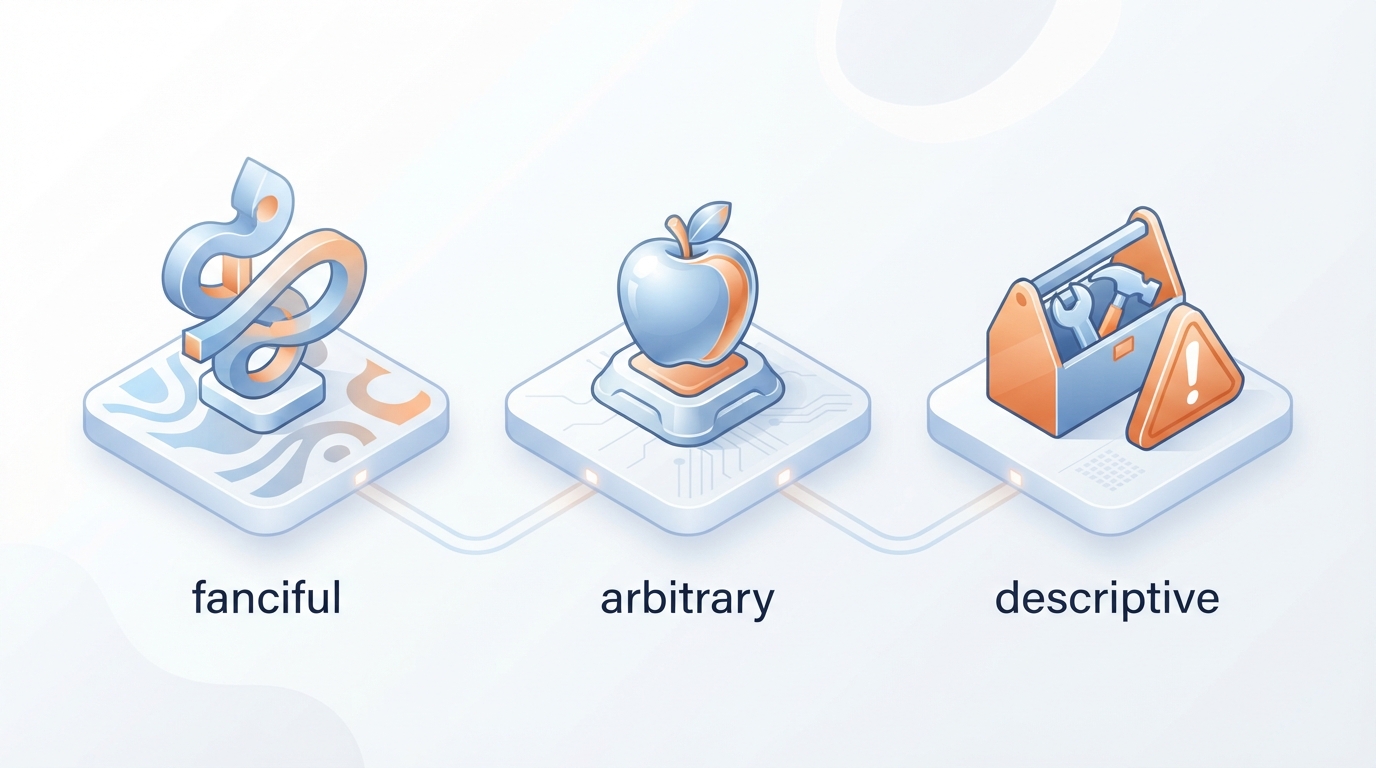
During the substantive examination stage, an expert analyzes whether your designation meets the conditions for granting legal protection. The most important criterion is distinctiveness: if a name merely describes the characteristics of a product, it cannot be monopolized by a single business. For better understanding, we have prepared a comparison of designation categories:
| Type of designation | Characteristic | Example / Risk |
|---|---|---|
| Fanciful | Invented words that do not exist in the language. | Highest level of protection (e.g., Kodak). |
| Arbitrary | Known words that have no relation to the product. | High registrability (e.g., Apple for electronics). |
| Descriptive | Indicate the type, quality, or composition of the product. | High probability of receiving a preliminary refusal under Art. 6 of the Law, unless acquired distinctiveness is proven. |
In addition to descriptiveness, experts pay attention to whether the name misleads the consumer regarding the manufacturer or geographical origin. If you submit the name “French Essence” for perfumes produced in Kharkiv, the IP Office may quite reasonably send a preliminary refusal. To minimize such risks, it is worth studying the official requirements for documents and designations in advance, which will help form a secure protection strategy.
After assessing the registrability, the designation moves to the stage of checking for conflicts with the rights of other owners who have already registered similar trademarks.
Searching for similar applications in databases
During the qualification examination stage, IP Office specialists check the designation for compliance with Article 6 of the Law of Ukraine “On the Protection of Rights to Trademarks for Goods and Services.” The main goal is to identify conflicts with already registered or filed trademarks for related goods and services using internal databases and international registries.
At this stage, experts analyze the designation based on three types of similarity: phonetic (consonance), visual (design, fonts), and semantic (coincidence in meaning or translation). Special attention is paid to absolute grounds for refusal, for example, when the name is descriptive or misleading to the consumer.
- Filing: Registration of the application and payment of fees.
- Formal examination: Verification of documents (see our document guide for more details).
- Qualification examination: Search for similar designations and assessment of registrability.
- Publication: Display in the bulletin and opening of a 3-month window for oppositions.
What to do if the examination is delayed? To minimize the risks of receiving inquiries from the examination office, we recommend professional trademark registration, which includes a preliminary professional search. This allows for the resolution of conflicts before the official verification and helps avoid lengthy correspondence with the office.
How the publication process works
Successfully passing the qualification examination opens the final stage of the registration cycle, where the application becomes public. Here, we will examine the role of the official bulletin in legalizing a brand and the timeframes during which competitors may file an opposition against your trademark rights.
Publication of information in the official bulletin

The publication of application details in the official “Industrial Property” bulletin is the moment your intellectual property officially enters the public domain. The registration procedure for any brand includes this step as a safeguard against infringing on the rights of third parties. Once an examiner issues a positive conclusion, data regarding your mark is published online, signaling to the entire market that this brand is claiming state protection.
Publication serves as a legal notice. From this moment on, any interested party can review your name, the list of Nice Classification classes, and the priority date. For large companies, this is a signal to check whether the new application infringes upon their interests. For you, it means that the main part of the journey is behind you, and the state is prepared to issue a certificate, provided no substantiated objections are received from opponents.
Although publication may seem like a purely technical matter, it holds critical legal significance for protection. If you have decided to register a trademark on your own, this is the stage at which you should begin monitoring similar marks that may appear in the bulletin after yours, in order to protect your priority in a timely manner.
The openness of data in the bulletin triggers a specific time frame intended for legal discourse between the applicant and third parties.
Related material on the topic: How to register a trademark in Ukraine on your own.
Opposition period for third parties
Once the details of an application appear in the official bulletin, a critical stage begins that is often underestimated — the opposition period. Within three months, any person may file a reasoned opposition with the IP Office against the registration of your mark. This is a legal market tool that allows competitors or owners of similar brands to claim that your mark infringes on their rights or does not comply with legal requirements. At this stage, the trademark examination becomes public, and this is where risks arise that cannot be calculated solely through automated databases.
As a lawyer with 20 years of experience, I always emphasize: publication is not just a step toward a certificate, but also a “go” signal for patent trolls and aggressive competitors. If you did not conduct a professional search during the preparation stage, a third-party opposition can block the process even after a perfectly passed qualification check.
Most often, oppositions are based on claims that the new mark is confusingly similar to an already registered mark or misleads consumers regarding the manufacturer. If such a “greeting” from third parties reaches the IP Office, the applicant is granted the right to submit their counter-arguments. This turns the administrative procedure into an adversarial process, where the winner is the one whose legal position is supported by evidence of actual brand use or the absence of a risk of confusion in the eyes of the consumer.
What to do if the examination is delayed due to an opposition?
If you have received a copy of an opposition, you have a statutory period to prepare a response. Do not ignore this document — the expert may interpret your lack of reaction as an admission of the opponent’s claims. It is important to prepare a reasoned response that breaks down the third party’s arguments point by point, taking into account any potential Provisional Refusal and using case law and consumer survey findings, where appropriate.
To minimize such situations, it is critical to gather a full package of documents for brand registration and verify its compliance with all eligibility criteria even before filing the application. Proper preparation at the start allows the expert to form a positive conclusion faster, even if someone is trying to put spokes in the wheels of your business.
If you need help with this task, take advantage of our offer for trademark registration.
Examination Results and Next Steps
The successful completion of all examination stages at the IP Office is not a matter of luck, but the result of thorough preparation, where it is critical to consider all absolute grounds for refusal right from the start. Even if the examination is delayed or you have received a preliminary notice of refusal, this is not a reason to stop, but a signal to professionally defend your interests through a reasoned response. To minimize risks and navigate the path to obtaining a certificate without unnecessary stress, you can entrust the procedure to BrandR specialists, and in case of complex obstacles, learn how to properly prepare a response to the IP Office notice of refusal. A clear understanding of the internal logic of examiners and compliance with legal standards turn a complex legal process into a reliable foundation for your business.
Frequently Asked Questions
What are the benefits of conducting a preliminary search before filing an application?
A preliminary search is a preventive measure that allows you to assess the chances of successful registration before paying government fees. An examination at the IP Office may reveal trademarks that are confusingly similar and are already registered or currently under review.
A professional search helps to:
- Avoid refusal: you will learn about the existence of conflicting marks in advance.
- Save your budget: you do not waste money on application fees for a filing that is guaranteed to be refused due to a conflict with an existing brand.
- Adjust your strategy: if similar marks are found, you can modify elements of your logo or the phonetic form of your name before submitting your documents.
We recommend contacting trademark registration specialists to obtain professional analysis regarding your name.
How to calculate the optimal number of Nice Classification classes for trademark registration?
The International Classification of Goods and Services (Nice Classification) consists of 45 classes. The choice of classes determines the scope of your legal protection: your trademark will be protected only for the goods or services you have included in the application.
Key tips for selection:
- Analyze your current activities: choose classes that correspond to the goods you produce or the services you already provide.
- Consider strategic development: add classes in which you plan to operate within the next 2-3 years.
- Avoid “territory grabbing”: registration in all 45 classes is unjustifiably expensive. Furthermore, if a trademark is not used for 5 years, its registration can be canceled upon the request of third parties due to non-use.
Remember that once the application is submitted, it is impossible to expand the list of classes — you would have to file a new application.
Can I change the name or logo during the examination process?
According to current legislation, it is forbidden to make substantial changes to a submitted application. This rule is in place to ensure the principle of priority is not violated.
If you have discovered an error in the name or wish to significantly change the graphic elements of the logo after the application has already been submitted to the IP Office, you have two options:
- Make minor corrections (e.g., fixing a typo in a word), provided that this does not change the essence of the mark itself.
- Submit a new application with the updated version of the mark. It is advisable to do this as soon as possible to secure priority for the new version of the brand.
What is an “opposition” and who has the right to file one?
An opposition is an official procedure during which a third party objects to the registration of your trademark. This right can be exercised within a 3-month period following the official publication of your application details in the “Industrial Property” bulletin.
Who can file an opposition?
- Owners of previously registered trademarks who believe your mark is confusingly similar to theirs.
- Owners of trade names or other intellectual property rights whose rights are infringed by your registration.
- Persons who believe that your designation misleads consumers regarding the quality or geographical origin of the goods.
If an opposition is filed, you will receive a notification from the IP Office and have the right to provide your arguments and evidence to defend your position.
What to do if the examination is delayed for a long period?
The duration of an examination in Ukraine can vary from 18 to 22 months (under the standard procedure). If this timeframe is significantly exceeded, it may be due to a large number of requests from examiners or internal processes at the IP Office.
Your steps:
- Check the application status: use the official database on the IP Office website to see the current stage.
- Check your mail: ensure that you or your representative have not missed an examiner’s request (which requires action on your part).
- Contact your representative: if you filed through a patent attorney, they have the ability to officially inquire about the status of the case with the IP Office.
It is worth remembering that accelerating the procedure is only possible through the official payment of a fee for accelerated registration (if provided for by the current rules at the time of filing).