Product Design: Choosing Between a Patent and Copyright
When you create a new product, choosing the wrong protection tool can cost a brand its market position before sales even begin. Let’s examine the difference between a patent for an invention and copyright, and how to properly classify your object.
The Nature of the Object: What Exactly Are You Protecting?
Understanding whether you are protecting the form of expression or the technical essence of a product determines your security strategy. Below, we will analyze in detail the legal nuances of creative concepts and aesthetic solutions in industry.
Copyright: Protecting the Creative Concept
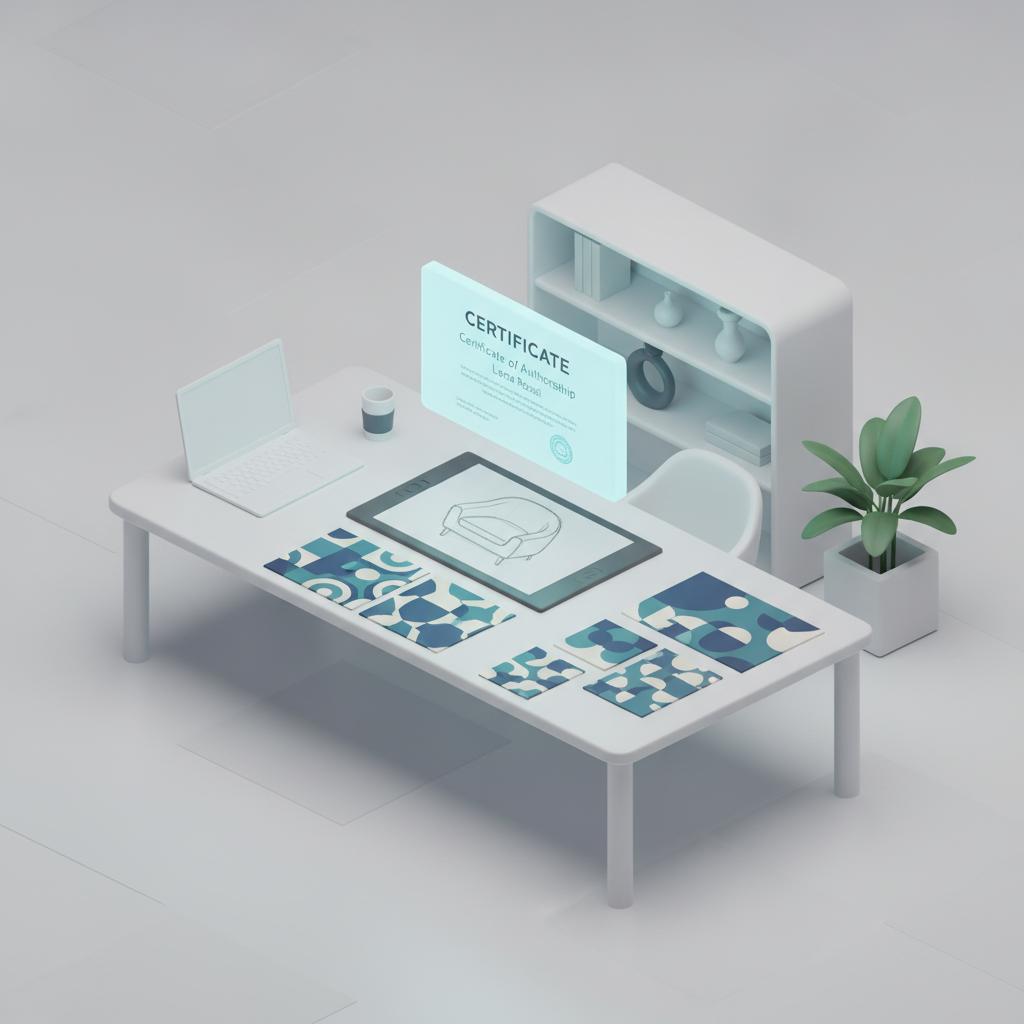
In the field of design, this mechanism is the “fastest” tool, as it arises automatically at the moment a work is created. This is critical for industries with a high turnover of collections, such as furniture design, the textile industry, or the development of unique prints. Unlike patent procedures, there is no need to wait months for an official examination to obtain a primary level of protection.
However, the automatic emergence of rights has a downside: the difficulty of proving priority in court. That is why for businesses planning large-scale expansion, state registration becomes a necessary step. An official Certificate from the IP Office (UANIPIO) records the date of creation and authorship, which significantly simplifies the fight against plagiarism on marketplaces or social networks.
Key advantages of using this tool for design protection:
- Long-term validity: protection lasts for the author’s entire life plus 70 years after their death.
- International protection: thanks to the Berne Convention, your work is protected almost everywhere in the world without additional registrations in each country.
- No maintenance required: unlike patents, you do not need to pay annual fees to keep your rights in force.
- Protection of the creative component: you protect the artistic image and unique visual execution, which is often the core of a startup’s identity.
Although this method is ideal for securing a creative concept, sometimes a visual concept requires stronger “armor,” which is provided by a design patent.
Industrial Design Patent: Protecting Aesthetics
An industrial design patent focuses on the visual characteristics of a product: its contours, lines, color palette, and material textures. Unlike protection for creative works, which arises automatically the moment they are created, patenting provides a legally established market monopoly, which is confirmed by the state after verifying compliance with novelty and individual character criteria (according to the IP Office of Ukraine).
Expert tip: If your product has high commercial potential, do not rely solely on “automatic” authorship. Registering an industrial design turns your design into an asset that can be included in authorized capital or used as a tool for legal protection against copying. For startup stages of a creative business, where rapid recording of rights is important, registration with the IP office is often advisable, as it provides flexible protection for design objects.
The choice between patenting and other protection methods depends on the business model and the nature of the object itself:
- Situation A (Industrial Design): You are planning mass production of a physical object (e.g., furniture or electronics). A patent protects the shape from being replicated by competitors.
- Situation B (Copyright): You are creating unique graphics, prints, or illustrations for packaging. Here, the creative component is key, not the functionality of the construction.
Disclaimer: This material is for informational purposes only and does not constitute official legal advice. The scope of rights and registration procedures are determined by current Ukrainian legislation and may depend on the specifics of your product.
Case Study: When Copyright Is Not Enough
We will examine practical situations where the choice between registering authorship and obtaining a patent determines a brand’s future in the market. You will learn about the risks of industrial copying and the conditions under which a creative vision requires stronger legal armor.
The Risk of Copying Industrial Products
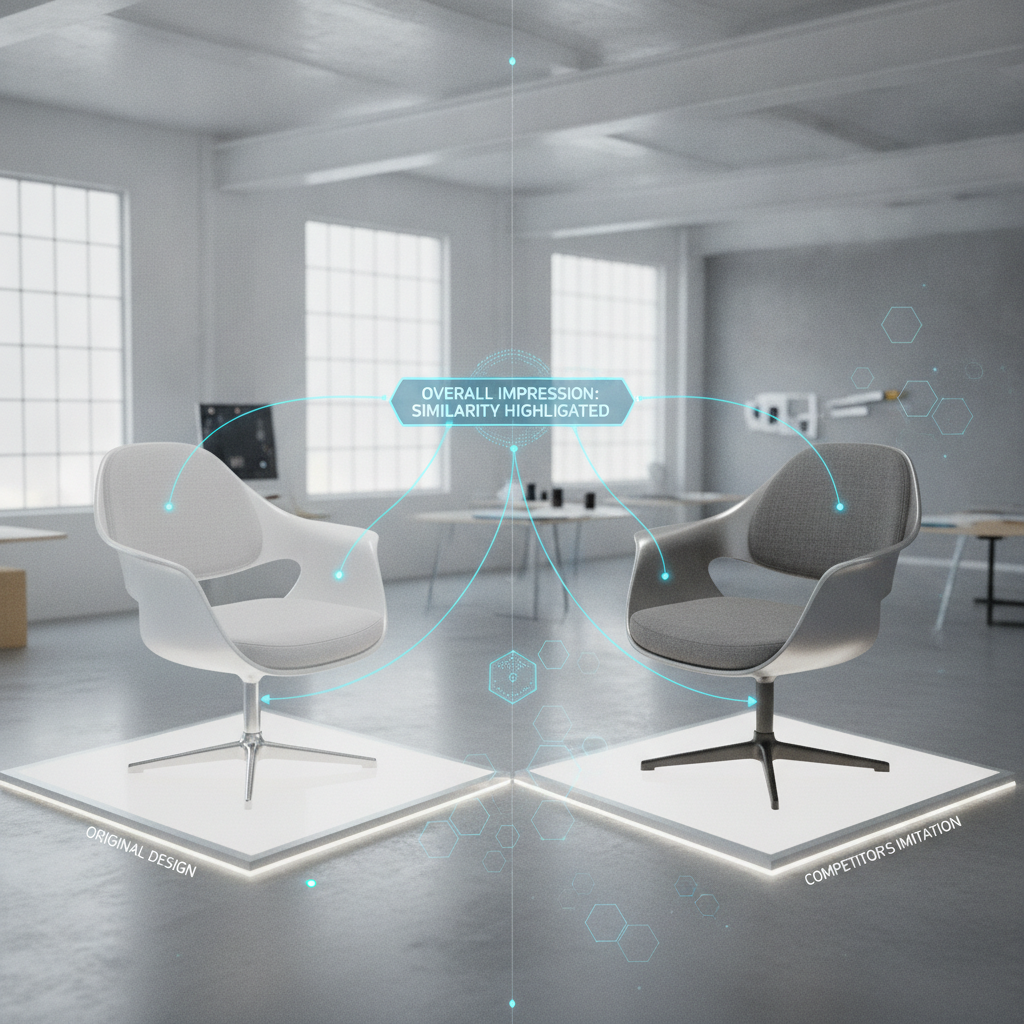
In the industrial sector, copying is rarely 100% identical: competitors often resort to minor modifications, attempting to circumvent legal restrictions. In such scenarios, legal protection based on creative expression proves limited, as it only protects the specific form, not the functional concept of the product. Conversely, an industrial design patent, according to the standards of the IP Office (UkrNOIVI), focuses on the “overall impression” that the design makes on an informed user, which allows for blocking goods even when cosmetic changes are present.
Case: Furniture design and imitation
Our client encountered a situation where a competitor released a chair identical in ergonomics, but with a slightly altered backrest angle and different hardware. An attempt at protection through copyright failed because the changes formally rendered the object “new.” Possessing an industrial design patent made it possible to argue infringement based on the identical overall visual impression, which allowed for settling the dispute out of court.
Comparison Table of Protection Strategies:
| Criterion | Copyright | Patent (Industrial Design) |
|---|---|---|
| Subject of protection | Creative expression (artistic value). | Appearance (lines, contours, shape). |
| Impact of minor tweaks | High risk of losing protection. | Protects if the overall image remains recognizable. |
| Method of proof | Proving the fact of appropriation. | Proving similarity of visual features. |
For businesses, choosing between these tools is a balance between accessibility and depth of protection. While copyright registration helps document the date of a work’s creation, a patent is a strategic tool for industrial production with the possibility of territorial expansion, particularly via the Hague System. If you aim to comprehensively protect your product, we recommend conducting an audit of your assets to determine the optimal form of legal protection.
When copyright works for you
Although an industrial design provides a powerful market monopoly, there are scenarios where intellectual property is protected by more flexible and cost-effective tools. This is particularly relevant for objects where artistic value outweighs the industrial form, or when the speed of bringing a product to market does not allow for waiting for official registration.
Unlike industrial design patenting, where novelty plays a key role, copyright protects the originality of the expression. If your design is a unique graphic print on fabric, an illustration for packaging, or a complex artistic composition on a device casing, such an object is protected as a work of fine art from the moment of its creation. Given the difference in the approaches to the origin of rights, this method of protection does not require mandatory formalities, which is critical for small businesses with limited budgets.
In cases where the budget is limited and the design lifecycle is short (for example, seasonal collections), it is worth focusing on documenting authorship. This allows you to avoid significant costs for maintaining a patent in force, while still retaining the option of legal action against direct copying. To strengthen your position, I always advise undergoing the voluntary registration procedure at the IP Office (UANIPIO), which provides an official Certificate — a strong argument in courts and when blocking content on marketplaces.
When choosing a protection method, we at the company follow this logic:
- Short lifecycle (up to 2 years): Choose copyright. It is free (or inexpensive with a certificate) and takes effect immediately.
- Unique graphics and decor: If the essence of the design lies in the pattern rather than the shape of the product, this protection is usually sufficient.
- Global online sales: The Berne Convention provides protection for works in 180+ countries automatically. At the same time, industrial design patents are territorial in nature, although there are international mechanisms for them, such as the Hague System for the International Registration of Industrial Designs.
Understanding these nuances allows you to avoid overpaying for excessive protection where the creative component is already reliably covered by law. Now it is worth understanding how to practically translate this knowledge into a comprehensive security strategy for your brand.
How to build reliable protection
Creating a reliable legal shield for a design requires a systematic approach that combines documenting authorship with strategic planning of registration procedures. Next, we will break down specific steps for verifying the object and provide advice on building an intellectual property portfolio.
Checklist for designers and businesses

For successful design protection, it is not enough to simply create a beautiful visual; you must ensure it meets legal criteria and is properly documented. Working with intellectual property for a startup often begins with an audit of the team’s creative output.
Before investing resources in preparing documents, you need to conduct an express analysis of the product. This will help determine whether copyright protection is sufficient for you or if you should prepare an application for an industrial design. I have prepared a list of questions that we ask clients during the first consultation:
- Is there proof of creation: Are the initial sketches, renders, files with metadata, or correspondence with the designer that confirm priority saved?
- Legal clarity of relationships: If the design was created by a freelancer or an employee, is there a signed agreement transferring property rights to the client?
- Level of originality: Does your product differ from existing market analogues in terms of overall impression, rather than just minor details?
- Publicity of the object: Was the design not made public on social media or at exhibitions more than 12 months ago (this is critical for patent novelty)?
- Commercial value: What is the planned sales period — will the profit justify the costs of state fees and legal support?
Such a check allows you to filter out weak objects and focus on protecting assets that form the brand’s uniqueness. The next step will be to form an individual strategy that takes into account the specifics of your niche and scaling plans.
Expert Advice on Strategy
Once we have analyzed the legal integrity of the relationship with the authors and verified the novelty of the object, the main question arises: how to turn these facts into capital. In my practice, brand owners often make the mistake of choosing only one path of protection, even though the modern market requires a hybrid approach. Understanding the differences between these concepts allows you not just to “stake a claim” to a design, but to create a multi-layered armor that is almost impossible for competitors to break.
My experience suggests: don’t be afraid to combine. If you are creating a unique piece of furniture, it is automatically protected as a work of art from the moment the sketch is created. However, if this chair has an innovative folding system or a specific shape that will become the “face” of the brand for decades, registering it as an industrial design will give you a monopoly right specifically on industrial replication. These are two parallel tools: one protects the creative soul of the product, the other protects its commercial body.
For an effective strategy, I recommend dividing the object into its component parts. For example, for a complex household device, the visual interface and graphic packaging elements should be protected by copyright, while the appearance of the housing should be protected by a patent. Such a distribution allows for budget optimization: you invest in more expensive patenting only where there is a risk of direct copying of the shape, while you protect graphics using faster tools. This is especially critical for startups, where resources are limited and speed to market determines business survival.
Such a multi-layered protection model lays the groundwork for the next logical step — the final choice of procedure that corresponds to your business cycle.
Related material on the topic: Patent for an invention or copyright.
If you need help with this task, use the copyright registration service.
Your Next Step in Design Protection
When choosing a protection strategy, remember that the main difference between a patent for an invention and other solutions lies in the focus of protection: technical solutions and market monopoly versus artistic form and long-term validity. For small businesses and startups, a rational start is often copyright registration, which allows you to fix authorship of sketches and design codes with minimal expenses. If your product has a unique design or shape that determines its commercial success, you should invest in patent protection, details on the criteria for which can be found in our comparative overview of IP tools. To avoid wasting time and to correctly classify your object at the Ukrainian National Office for Intellectual Property and Innovations (UANIPIO), seek professional advice from Brandr experts — we will help you build protection that actually works in court and on the market.
Frequently Asked Questions
Can I protect my product design as a trademark?
Yes, it is possible, but it is important to understand that a trademark (TM) does not protect the functional design or aesthetics of a product, but rather its distinctiveness as a source of goods.
- If the shape of your product is so unique that consumers associate it exclusively with your brand (e.g., the shape of a Coca-Cola bottle), you can register it as a 3D trademark.
- Unlike a patent, which has a limited term, a trademark can be renewed every 10 years indefinitely.
- A trademark does not grant a monopoly on a technical solution or aesthetic appearance; it prohibits competitors from using similar designations that could mislead a buyer.
We recommend combining tools: copyright registration for graphic elements, an industrial design patent for the shape, and trademark registration for the name or recognizable logo.
How can I prove authorship if I haven’t officially registered the design?
Although copyright arises automatically the moment an object is created, proving authorship in court without official documentation can be difficult. To protect yourself, use the following methods:
- Deposition: Official copyright registration in the state registry, which provides undeniable proof of the date of creation and authorship.
- Digital footprints: Storing source files (PSD, AI, CAD models) with version history and metadata.
- Notarization: Documenting the existence of sketches or prototypes as of a specific date.
- Publication: Early disclosure of the design (e.g., on social media or an official website) with the copyright symbol ©, year, and owner’s name.
What should I do if my design is stolen in another country?
Intellectual property protection is territorial. This means that a patent or registration in Ukraine is only valid within Ukraine. If you are planning to enter the international market:
- For industrial designs, it is worth using the Hague System, which allows you to file one international application for protection in many countries simultaneously.
- Copyright is protected by the international Berne Convention, which applies in 180+ countries, but even in this case, having a registration certificate in your home country significantly facilitates proving rights in a foreign court.
We recommend being proactive: if you are planning to export, evaluate your target markets and register your rights before starting active sales in those jurisdictions.
Can I change my protection strategy if I have already launched the product on the market?
Changing your strategy is possible, but it has a critical limitation — the novelty requirement. For an industrial design patent in Ukraine, there is a grace period of 12 months from the date of first disclosure.
This means that if you showed the product at an exhibition or listed it in an online store, you have exactly one year to file a patent application. After this period expires, the design is considered “prior art,” and it will be impossible to obtain a patent. There are no time restrictions on publication for copyright, which is why it remains a “lifeline” for those who have missed the patent registration deadlines.
Does an industrial design patent protect the internal mechanisms of a product?
It is important to distinguish between objects: an industrial design (design patent) protects only the external appearance — what is visible to the eye. It does not protect technical solutions, internal structure, or the operating principle of a product.
If your product has a unique design or functional feature, you need to file an application for a patent for an invention or a utility model. An industrial design will protect you against visual copies, while a patent for an invention protects against the copying of internal technology. The best protection for an innovative product is a combination of a patent for an invention (functionality) and an industrial design (appearance).